July 30, 2026
Virtual Receptionist Pricing: The Real Per-Minute Math for 2026
Virtual receptionist pricing in 2026: real per-minute rates, overage tiers, hidden fees, and the cost-per-booked-job math pricing pages never show.
Part of our guide: ai receptionist for small business
TL;DR: A virtual receptionist costs $250 to $1,725 a month in 2026, sold as minute bundles that work out to $3.29 to $5.00 per minute at entry tiers. Overage minutes run $2.50 to $2.99, per-call plans reach $10 or more, and add-on fees stack fast. The advertised monthly price is not the real number. The real number is cost per booked job, and this post shows that math.
Every virtual receptionist pricing page shows you one friendly number: the monthly plan price. The invoice tells a different story. The plan price only buys a bundle of minutes, and your phone traffic (call length, call volume, the week a storm or heat wave hits) decides what you actually pay. I built RestorationAI.io after my uncle lost an $80,000 job to a single missed call, so I have spent years studying what answering the phone really costs a service business. This post is part of our complete guide to the AI receptionist for small business.
Below is the arithmetic the sales pages skip: real 2026 plan prices from Ruby, Abby Connect, and Smith.ai, the per-minute rates hiding inside those bundles, the overage tiers that inflate quiet-month plans on busy months, and the one metric I think every owner should actually optimize: what each booked job costs you.
How much does a virtual receptionist cost?
A virtual receptionist costs $250 to $1,725 per month in 2026, sold as bundles of 50 to 500 live receptionist minutes, which works out to $3.29 to $5.00 per minute at the entry tiers most small businesses buy. AI receptionist plans covering the same minutes run $99 to $690 per month.
Here are the published 2026 numbers, with the per-minute rate each plan actually charges:
| Provider and plan | Monthly price | What you get | Effective rate |
|---|---|---|---|
| Ruby Starter | $250 | 50 minutes | $5.00 per minute |
| Ruby Standard | $395 | 100 minutes | $3.95 per minute |
| Abby Connect Essential (live) | $329 | 100 minutes | $3.29 per minute |
| Abby Connect Essential (AI) | $165 | 100 minutes | $1.65 per minute |
| Smith.ai Starter | $300 | 30 calls | $10.00 per call |
| AnswerConnect | $325 to $350 | 200 minutes | About $1.70 per minute |
| Moneypenny basic | $99 | Small bundle | $2.99 per overage minute |
Two things jump out of that table. First, the branded virtual receptionist tier (Ruby, Abby) charges two to four times the $0.75 to $1.50 per minute that generic answering services charge, because you are paying for polish, scheduling, and warm transfers. Second, the cheapest plans carry the most expensive minutes. The $250 plan sells minutes at $5.00. The $1,725 plan sells them at $3.45. Entry pricing is designed to move you up the ladder.
If you are still deciding between a receptionist service and the broader answering-service market, I broke down that whole landscape in our answering service for small business guide.
How does per-minute virtual receptionist pricing actually work?
Per-minute pricing means your plan buys a fixed bundle of receptionist minutes each month, every answered call draws that bundle down, most providers round each call up to the next full minute, and once the bundle runs out, every additional minute bills at a premium overage rate.
The rounding detail matters more than it looks. Industry pricing guides confirm that calls are billed to the next nearest minute, so a one-minute-ten-second call bills as two minutes. Stack 60 calls a month and rounding alone can quietly consume 15 to 25 minutes of your bundle. That is real money at $3.29 to $5.00 a minute.
Now add call length. In my years on the truck, no panicked homeowner ever explained a flooded kitchen in ninety seconds. Real emergency intakes run four to six minutes, and per-minute billing quietly loves that. A 50-minute Ruby Starter bundle is about 12 four-minute intake calls. If your phone rings 12 times in the first nine days of the month, the remaining three weeks bill at overage rates, and overage minutes run $2.50 per extra minute at AnswerConnect and $2.99 per extra minute at Abby Connect.
 The plan is priced for your quiet month. The invoice is set by your busy one.
What hidden fees show up in virtual receptionist plans?
Five fees to check before you sign anything: setup charges of $50 to $200, overage minutes at $2.50 to $2.99, per-action fees like $1.50 per appointment booked, monthly feature fees for recording and routing, and premium pricing for bilingual or after-hours coverage.
Here is each one with real 2026 numbers:
- Setup and script fees. Many providers charge a one-time $50 to $200 fee to configure your account and script, and script development alone can run $50 to $150.
- Overage rates. The per-minute price after your bundle is gone: $2.99 at Abby Connect, $2.50 at AnswerConnect, $2.99 at Moneypenny. On per-call plans it is steeper: Smith.ai charges $8.50 to $11.50 per overage call depending on tier.
- Per-action fees. On Smith.ai’s published rate card, appointment booking adds $1.50 per call, complex call routing $1.50, a dedicated Spanish line $1.00, and call recording $0.25 per call. The receptionist doing the useful part of the job is the add-on.
- Monthly feature fees. Elsewhere in the market, call recording runs $10 to $30 a month, intelligent routing $25 to $50, and appointment scheduling $20 to $50.
- Bilingual and after-hours premiums. Multilingual coverage typically adds 10 to 20% to the bill, and some services still treat nights and weekends as a paid tier. For a field business, that is backwards: the after-hours call is the job, which is why we wrote a whole after-hours answering service guide about it.
Run the worked example. A $329 Abby Essential plan, plus 30 overage minutes in a busy week ($90), plus a scheduling add-on, invoices well north of $450. The pricing page said $329. Nobody lied. They just showed you the floor.
Virtual receptionist vs AI receptionist pricing: which is cheaper?
AI receptionist pricing is cheaper at every published tier, and Abby Connect proves it on its own pricing page: it sells the same minute bundles both ways, and the AI plans cost about half the live plans, $165 versus $329 for 100 minutes and $690 versus $1,380 for 500 minutes.
The side-by-side across the market:
| Minutes per month | Live receptionist | AI receptionist |
|---|---|---|
| 100 minutes | $329 to $395 | $165 |
| 200 minutes | $599 to $720 | $299 |
| 500 minutes | $1,380 to $1,725 | $690 |
| Generic AI answering | $50 to $300 flat |
Here is the arithmetic no pricing page prints: entry live plans sell minutes at $3.29 to $5.00 each, then bill up to $2.99 a minute once you run out. The plan is priced for your quiet month, and your invoice is set by your busy one. AI flipped that model. Flat pricing means the busy month, the one where the jobs are, is the month your cost per call drops.
The honest caveat: some callers want a human, and a good AI setup hands those calls off instead of fighting them. But the pricing logic is not close, and it gets less close as you grow, because a live service has to staff more seats while software just answers more lines at once. I ran the full head-to-head, including intake quality and surge weeks, in our answering service versus AI breakdown.
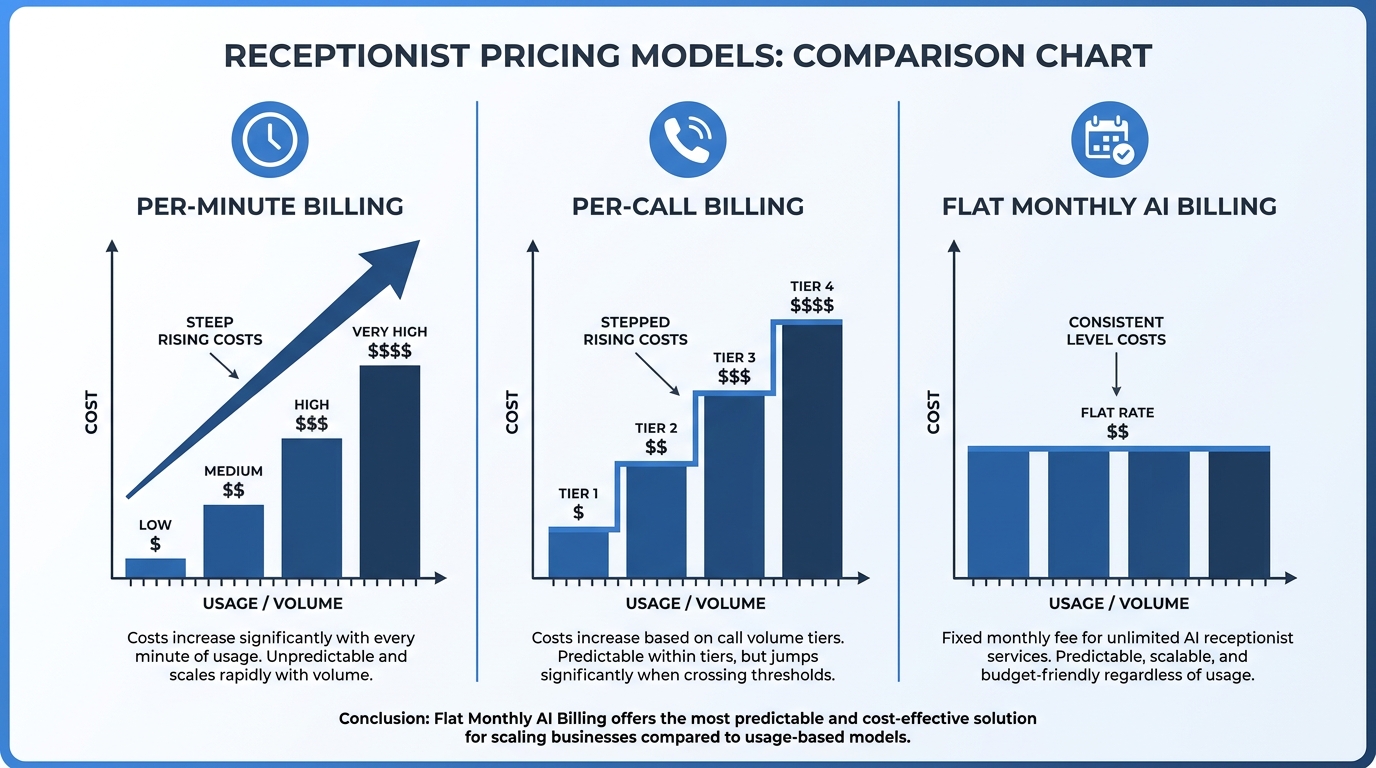 Three billing models, three very different busy-month invoices. Sources: Ruby, Abby Connect, and Smith.ai published 2026 pricing.
What does a virtual receptionist cost per booked job?
Divide the full monthly invoice by the number of jobs the service actually booked, not the number of calls it answered: a $329, 100-minute live plan handles about 25 four-minute calls, and if 40% of those callers end up as booked work, you paid about $33 per booked job before a single overage minute or add-on fee.
That is the honest version. The uglier version is more common. Most virtual receptionist plans do not book field-service work at all. They take a message, and the job then depends on how fast you call back from a crawl space. If the service books zero jobs, your cost per booked job is not $33. It is undefined, and the monthly fee is rent on a notepad.
This is where I will show our own math, since transparency is the whole point of this post. Our Leakproof plan is $297 a month plus $0.45 per minute, and Rapid Response is $597 plus $0.20 per minute with dispatch, work authorizations, and CRM write-back included. For a mid-size service company handling 150 calls a month, that lands around $2.32 per call, versus the $8 to $14 per call typical of live services at that volume. Across our contractor deployments, calls convert at better than 70% because the AI books and dispatches in the same call instead of relaying a message. And in restoration, the stakes end the debate quickly: one $5,000 water job that reached a competitor first pays for a year of any plan in this article.
Per-minute versus per-call versus flat is only half the buying decision. The other half is what the software can actually do during the call, and I published my full scoring rubric in our AI receptionist software buyer’s guide.
How do you avoid overpaying for a virtual receptionist?
Price every plan against your real call traffic, not the provider’s example customer: pull last month’s phone log, multiply your call count by your average call length, add 20% for minute rounding, and only then compare plans, starting with the overage rate instead of the monthly price.
The five-step version I give owners:
- Audit your log first. Count calls in, average call length, and what share arrive after hours. That is your real minute demand.
- Add a rounding buffer. Billed minutes run higher than talked minutes. Assume 20% inflation on short-call traffic.
- Read the overage rate before the plan price. The overage rate is what you pay in the month that matters. A cheap bundle with a $2.99 overage is an expensive plan wearing a costume.
- Get the full fee schedule in writing. Setup, per-action fees, feature fees, after-hours tiers, bilingual premiums. If it is not in writing, it is in your invoice.
- Judge quotes in cost per booked job. Not cost per month, not cost per minute. If a service cannot book or dispatch work, that number never gets good.
If you want the shortcut, run your numbers against us. Book a strategy call at restorationai.io and bring your last phone bill and your ugliest busy week. We will price it three ways (live, virtual, AI), show you the intake, the dispatch ping, and the job card landing in your CRM, and let the cost-per-booked-job math make the call.