June 29, 2026
Restoration Answering Service vs AI: The Real Cost Per Booked Job
Restoration answering service vs AI compared: real cost per call, storm-surge performance, and which one actually books more restoration jobs in 2026.
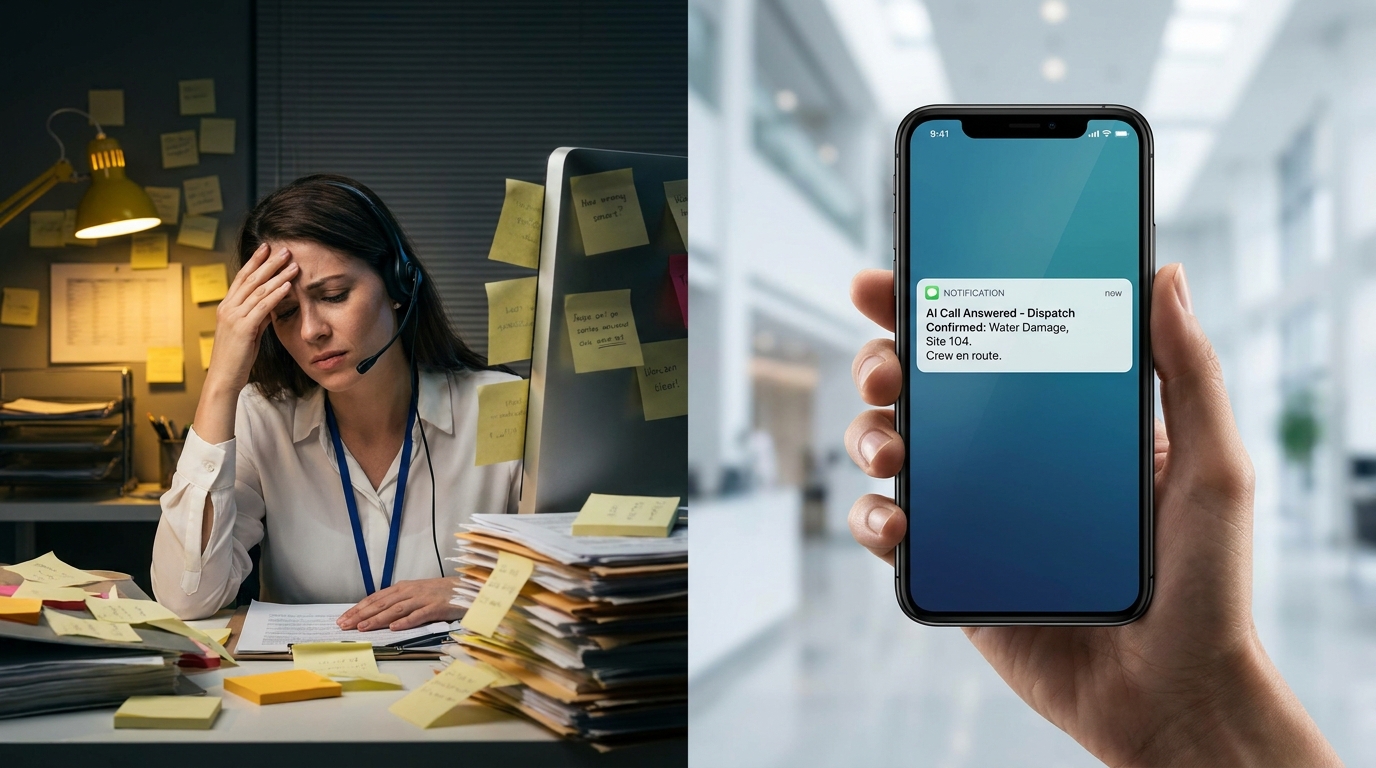
TL;DR: A traditional restoration answering service costs roughly $8 to $14 per call once you add per-minute billing, after-hours premiums, and patch fees. An AI answering service runs closer to $2.32 per call at mid-volume and never drops a call during a storm surge. The honest comparison is not cost per call, it is cost per booked job. A live service that is cheaper per minute but misses half your 2 AM and storm calls is far more expensive per job won. For emergency restoration work, AI wins on speed, surge capacity, and price, while a human still edges it on rare, emotionally complex calls.
If you are weighing a restoration answering service against an AI receptionist, you are really asking one question: which one books more jobs for less money? Most comparison articles answer the wrong version of that question. They line up monthly prices and feature checklists, then call it a day.
That misses the whole point of restoration. Your calls do not arrive politely between 9 and 5. They come in at 2 AM with a burst pipe, or ten at once when a storm rolls through. The service that costs a little less per minute but cannot answer ten calls at once just handed your biggest week of the year to a competitor.
I built RestorationAI.io after my uncle lost an $80,000 condo job to a single missed call. So I look at this comparison through one lens only: what actually captures the job. Let me break down the real numbers, the surge problem nobody mentions, and where a human still beats the machine.
What does a traditional restoration answering service actually cost per call?
A traditional restoration answering service costs about $8 to $14 per call once you add up per-minute billing, after-hours premiums, and patch fees. The sticker price looks small, but restoration intake calls run long and the extras stack up fast.
Here is how it adds up. Most live services bill by the minute, typically $0.90 to $1.50 per operator minute, and a real restoration intake (address, loss type, category, insurance, authorization) runs six to eight minutes. That alone is $5 to $12. Then come the extras the same guide lists: setup fees of $50 to $500, holiday surcharges at 1.5 to 2x, after-hours premiums, and patch or transfer fees of $0.50 to $2.00 per call. Miss your included minutes and overage rates climb higher.
The bigger problem is what you pay for and still do not get. You are billed for every call the operator answers, including the solicitor, the wrong-number, and the tenant with no authority to approve work. A message that says “water damage, call back” costs you the same as a fully qualified emergency lead.
In my years on the truck, the jobs we lost were almost never about price. They were about who picked up first. A message relayed at 8 AM is not a lead, it is a postmortem.
Can an AI answering service qualify restoration leads as well as a human can?
Yes, and on structured restoration intake it is often more consistent than a human operator. A general answering service reads from a script it was handed last week. A purpose-built AI knows IICRC S500 water categories cold and asks the right triage questions on every single call, never tired, never rushed.
That consistency is the whole game. The AI captures the property address, the loss type, the source of damage, the affected areas, the insurance carrier and claim status, and homeowner authorization, then it writes all of it straight into your CRM before the caller hangs up. A remote operator taking notes on a generic pad does not know to ask whether the water is Category 1, 2, or 3, or why that changes the dispatch urgency.
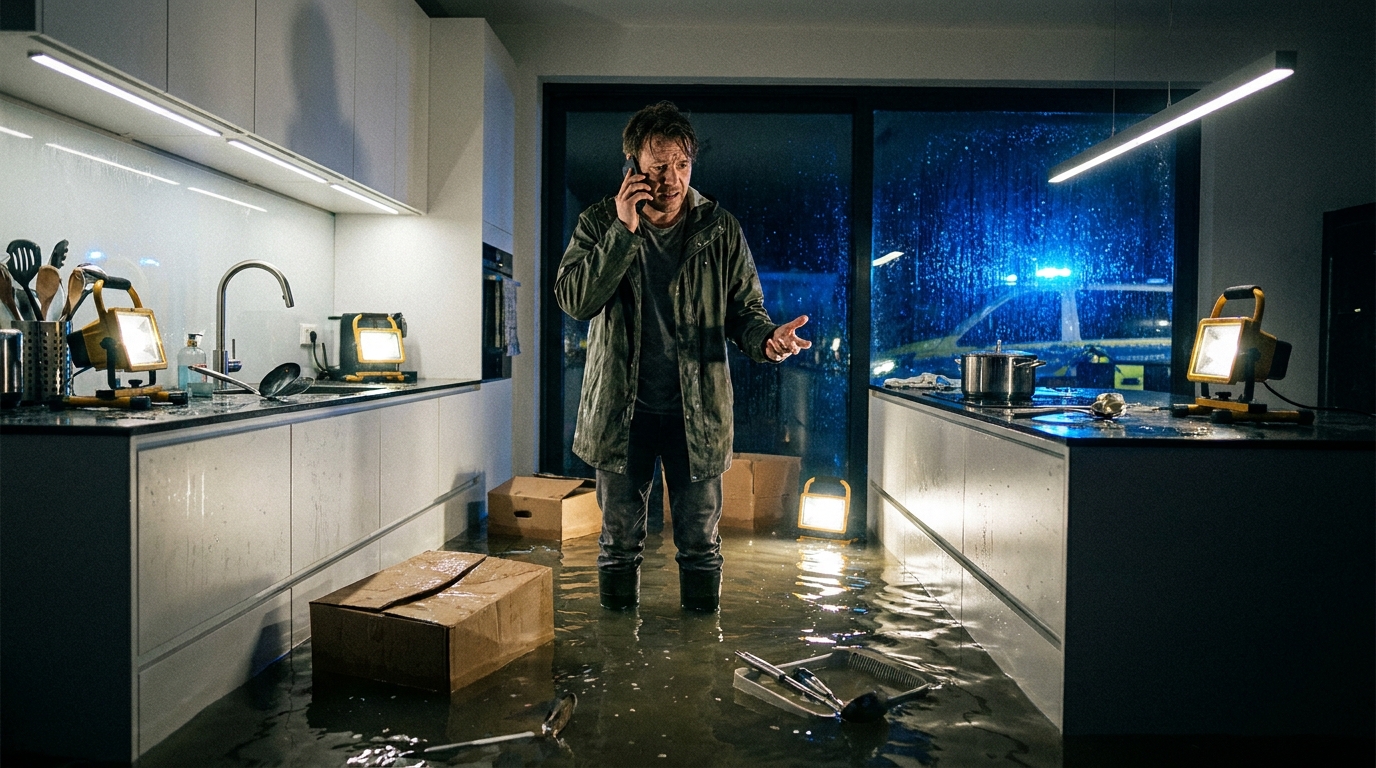 The emergency caller is not comparison shopping. They hire the first qualified voice that answers.
This is where the “answering” framing falls apart for restoration. Answering the call is the easy part. The job is qualifying the loss, sending the work authorization, and dispatching a crew, all before the homeowner dials the next contractor. We go deeper on that intake-to-dispatch logic in our guide on what an AI receptionist actually does on a restoration intake call. A message-taker simply cannot reach that bar.
What happens during storm surge when call volume spikes, AI vs live service?
During a storm surge, an AI answers every call at once while a live service drops the overflow, and the overflow is where the biggest losses live. When severe weather hits, contractor call volume can spike 500% in a matter of hours, turning a normal 15 to 20 calls a day into 80 to 120 overnight.
No human answering service is staffed for that. Operators answer one call at a time, so callers eleven through thirty hit a hold queue or voicemail. That matters because 85% of callers who do not reach a live answer will not call back, and after a storm 68% of homeowners hire the first contractor who picks up. The surge is precisely when the largest losses get assigned, and a queue gives them all away.
An AI has no concurrency limit. Ten calls at 9 AM Monday are all answered on the first ring with no extra per-seat cost and no busy signal. The companies that capture a storm are not the ones with the biggest phone room, they are the ones whose line never gave a busy signal at 3 AM. This is the single strongest argument for AI in restoration, and we cover the night-and-weekend version of it in our breakdown of why the after-hours call is the job you cannot afford to miss.
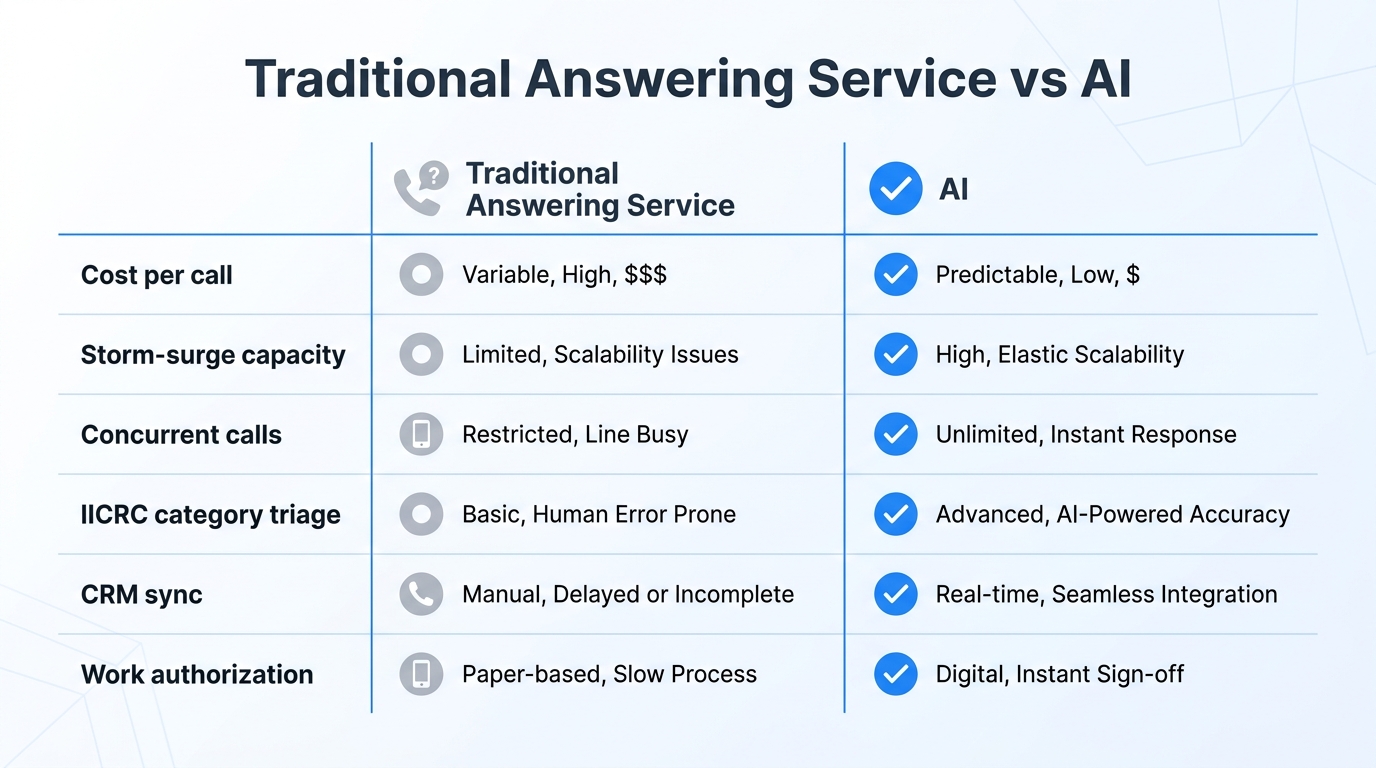 Where the two models diverge most: surge capacity, category triage, and instant CRM write-back.
Does switching to AI hurt the customer experience for distressed homeowners?
For most emergency calls, no, because the thing a distressed homeowner wants most is an instant, calm answer and a confirmed arrival time, which is exactly what AI delivers. Speed is the experience. A caller standing in water does not feel cared for by a hold queue.
The honest caveat: empathy still matters, and it is a real concern. Research shows 67% of consumers say empathy and friendliness in AI agents are important, and a share of people still prefer a human for sensitive moments. So the answer is not to pretend AI is human. It is to deploy AI where speed wins (the first answer, the triage, the dispatch) and route the rare, emotionally complex call to a person. By 2026 the best systems hold a conversation most callers cannot distinguish from a live operator, and they never put a scared homeowner on hold.
There is also a quieter customer-experience win: accuracy. When the AI texts the homeowner a confirmation with an arrival window and a visual intake link to upload photos of the damage, the customer feels handled, and your tech shows up with the right equipment. That beats a callback at 8 AM asking them to re-explain the whole emergency.
What is the ROI comparison: AI receptionist vs hiring a full-time receptionist?
An AI receptionist wins the ROI comparison decisively, because a full-time hire costs $50,000 or more all-in and still only covers 40 hours a week. The fully loaded cost of one receptionist (salary plus payroll taxes and benefits) runs around $50,000 a year and up, on a base salary that averages about $37,000.
Here is the math that matters for restoration. One person cannot cover nights, weekends, holidays, or a storm surge, so to truly never miss a call you need three to four of them, or a hybrid with after-hours overflow. Compare that to a flat AI plan. As call volume grows to 100, 200, or 500 calls a month, an AI receptionist stays around $199 to $597 a month while a live service climbs past $1,500 with overage fees.
Now reframe it as cost per booked job, the only number that pays your bills:
- Live answering service: $8 to $14 per call, drops surge and after-hours overflow, relays messages instead of dispatching.
- Full-time receptionist: $50,000+ per year, covers one shift, out sick or asleep for most of your emergency calls.
- AI answering service: about $2.32 per call at mid-volume, answers unlimited calls at once, qualifies and dispatches before the homeowner hangs up.
When a single booked water job runs $3,000 to $7,000, and a commercial loss runs $25,000 to $100,000 or more, the service that captures one extra job a month pays for itself many times over. Speed and surge capacity, not per-minute price, decide who books it. The same logic drives our deep dive on how an AI answering service helps restoration companies never miss a lead.
Restoration answering service vs AI: which should you choose?
Choose AI if your jobs hinge on answering first, surviving storm surges, and dispatching fast, which describes nearly every restoration company. Choose a human service only if your call volume is low, predictable, and rarely an emergency, which describes almost none of them.
The decision is not really “robot versus person.” It is “instant, unlimited, dispatch-ready coverage versus a message taken by one operator during one shift.” For water, fire, and mold work, where the first three days of a loss are worth more than all the days after, and where the first responder wins 78% of the time, the math is not close.
My honest take: run AI as your front line for every call, and keep a human in the loop only for the handful of conversations that genuinely need one. You get the speed and surge capacity that win restoration jobs, at a fraction of the per-call cost, without ever sending a 2 AM emergency to voicemail.
If you want to see exactly how the triage, work authorization, and dispatch logic works on a live restoration call, book a strategy call and we will map your current coverage gap and show you what answering every call would do for your bookings.