June 26, 2026
AI Receptionist for Restoration Companies: What It Actually Does on an Emergency Call
A generic AI receptionist takes a message. A restoration one triages the IICRC water category, routes the insurance carrier, and dispatches a crew in a single call. Here is what to expect, and what it costs.
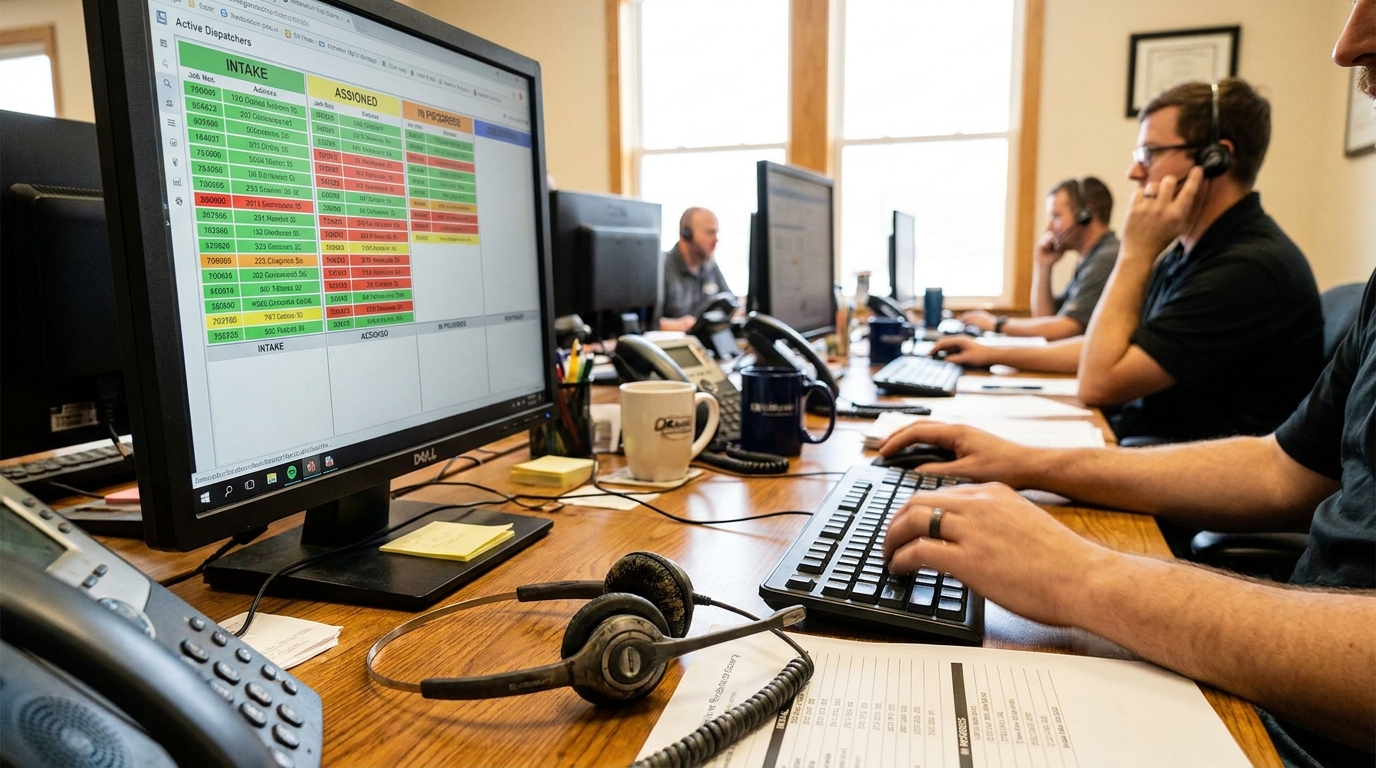
TL;DR: An AI receptionist for restoration companies answers every call 24/7, but the part that matters is what it does next. A generic AI phone tool takes a name and number. A restoration-specific one triages the IICRC water category, captures the insurance carrier and claim details, checks crew availability, and dispatches, all in one call. Restoration contractors miss roughly a quarter of their calls, and 78% of those callers never call back, so the receptionist that books the job is the one that answers the first time and handles the emergency correctly.
Most “AI receptionist” guides are written for dentists and law firms. Restoration is a different animal. Your caller is not booking a cleaning six weeks out. They have water pouring through a ceiling at 11pm, and the company that answers with a calm voice and a crew on the way wins the job before anyone else picks up.
In my six years working as a restoration tech, the jobs we lost were rarely about price. They were about a phone going to voicemail while a competitor said “we will be there in an hour.” An AI receptionist exists to make sure your phone is never the one that goes quiet.
What does an AI receptionist actually do on a restoration intake call?
It answers instantly, runs a real emergency intake, and dispatches your crew, instead of just taking a message. A restoration AI receptionist greets the caller in your company name, asks what happened, captures the property address, identifies the type and severity of the loss, asks whether an insurance claim has been filed, and then alerts your on-call team. The best systems answer 24/7, qualify the lead, book or dispatch, and text the caller back if they hang up, all without a human in the seat.
The difference from a generic tool is the intake logic. A general receptionist platform is built to collect a name and an appointment slot. A restoration platform is built to make an operational decision at 2am: is this a job we roll on tonight, or a callback for the morning?
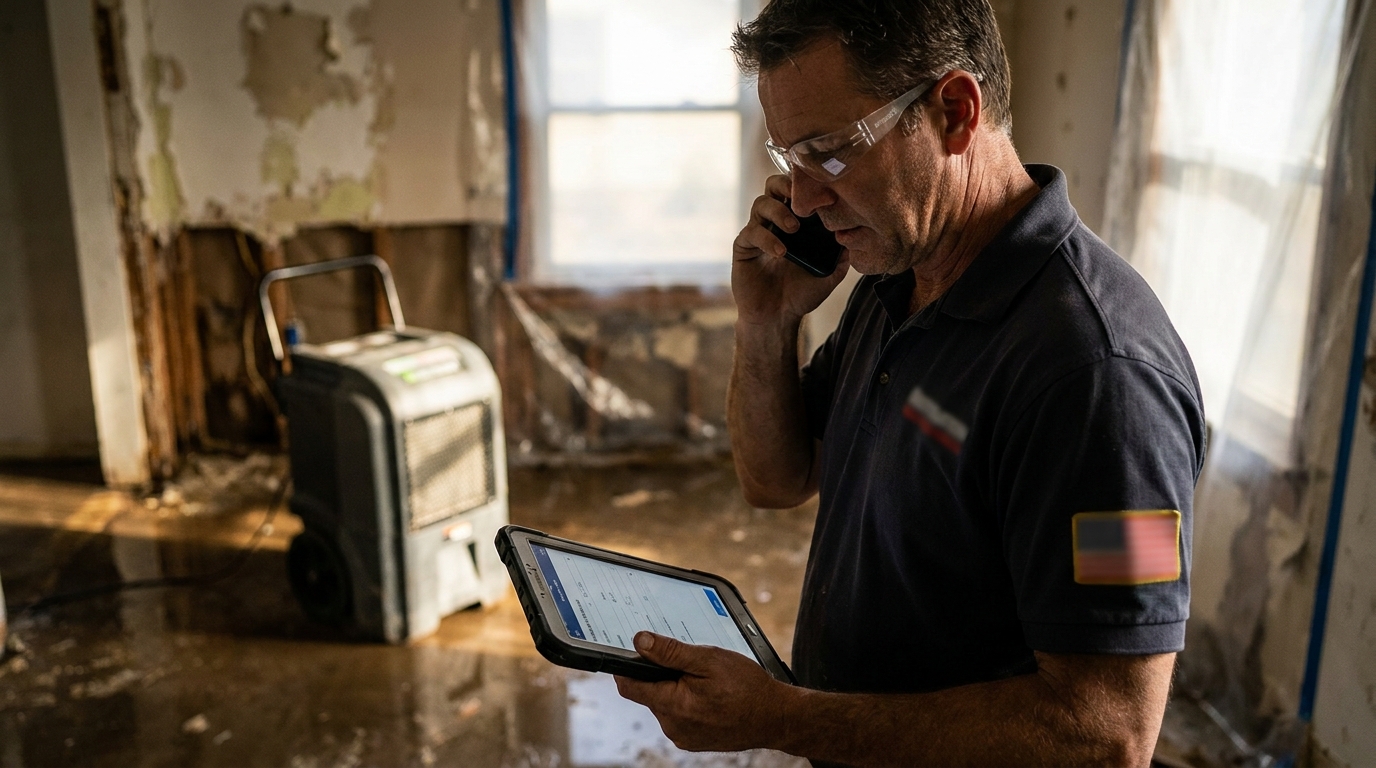 A restoration intake is an operational decision, not a message slip.
Why does a generic AI receptionist fail restoration companies?
Because a generic receptionist is built to book appointments, not to triage emergencies, and restoration is all emergencies. A general-purpose AI phone tool can take a name, a number, and a preferred time. It cannot tell a Category 1 supply-line leak from a Category 3 sewage backup, it does not know to capture the insurance carrier and claim number, and it has no concept of which crew is on call tonight. For a restoration company, those three things, water category, insurance routing, and crew availability, are the entire call.
The stakes are higher than most owners realize. When crews are out on jobs, as many as 62% of contractor calls go unanswered, and the average missed call is worth about $1,200 in lost work. Restoration makes that worse, because 31% of emergency calls land after hours when no one is at a desk, and a flooded homeowner will not wait. A receptionist that simply “answers” is not enough. It has to answer like a restoration dispatcher.
Can an AI receptionist handle Category 3 water loss calls correctly?
Yes, if it is trained on IICRC categories, which is exactly where generic tools fall down. A restoration AI receptionist asks the questions that determine contamination level, what is the source of the water, is it discolored, is there a sewage smell, and classifies the loss as Category 1, 2, or 3. That classification drives urgency: a clean-water supply line can wait a few hours, but a Category 3 sewage backup cannot, because mold growth can begin within 24 to 48 hours of water intrusion.
This is the heart of what makes a restoration receptionist different. A generic bot hears “water in the basement” and books a slot. A trained one recognizes a biohazard, flags it as an emergency, and pushes it straight to dispatch. We go deeper on that triage logic in our guide to the after-hours answering service call.
When I was running intake, the calls that hurt most were the Category 3 jobs that got logged as routine. By the time someone called back, the homeowner had already hired the company that treated it like the emergency it was.
How does AI dispatch differ from a traditional answering service?
A traditional answering service relays a message; an AI receptionist makes the dispatch happen. A live answering service collects details and texts or emails them to you, then you call the crew. That hand-off adds time, and time is the whole game when responding within 5 minutes makes you 21x more likely to qualify the lead than waiting 30.
A restoration AI receptionist closes that gap by dispatching directly. It calls and texts your on-call technician, and a good system is relentless about it: it rings the first tech several times, and if no one answers, it escalates to the next in line until someone verbally confirms they are rolling. There is no message sitting in an inbox waiting for you to wake up. For the deeper cost and conversion comparison, see our breakdown of how AI answering services help restoration companies never miss a lead.
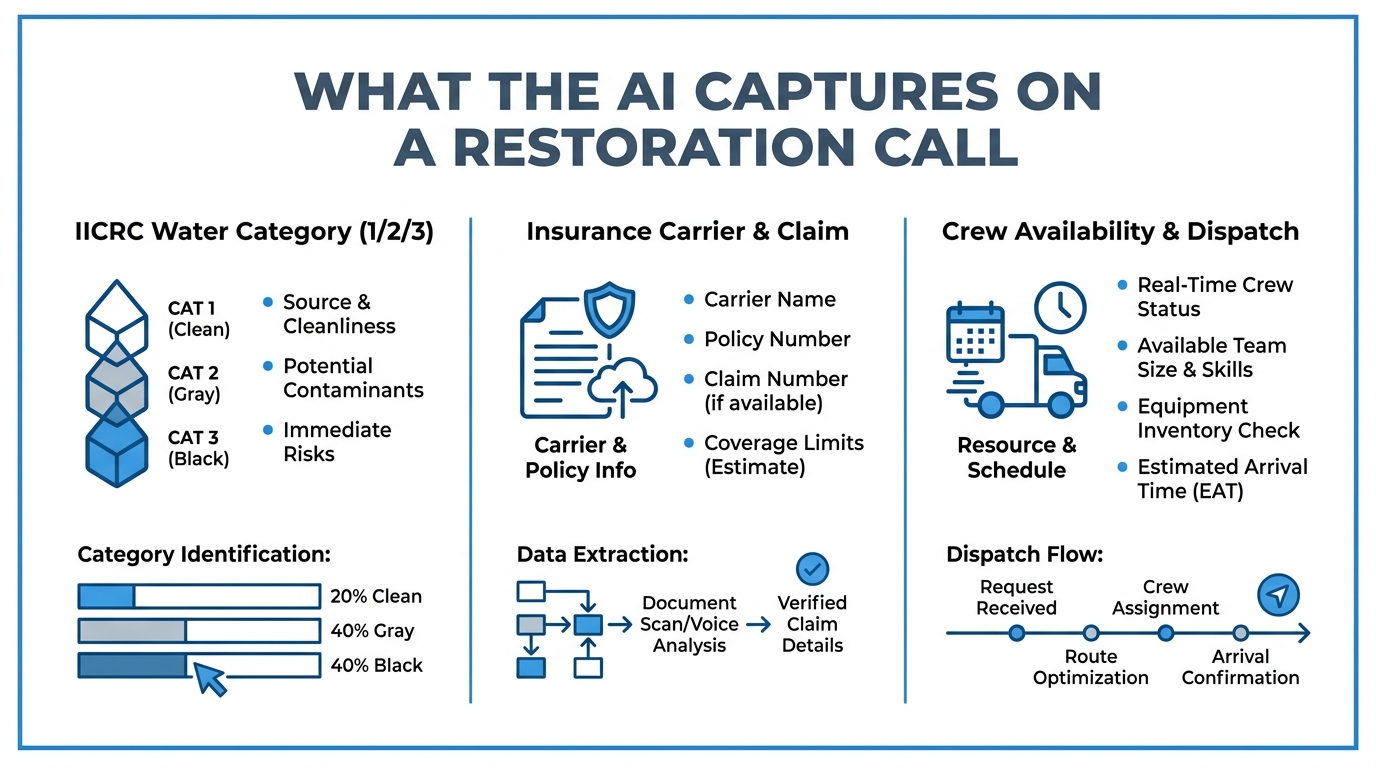 The three things a restoration receptionist must capture that a generic one ignores.
Will an AI receptionist work with my existing CRM (JobNimbus, Albiware, Xcelerate)?
Yes, a restoration AI receptionist connects to your existing job-management software so the record is built before the call ends. Modern contractor AI receptionists integrate directly with field service and CRM systems, and for restoration that means pushing a populated job into the tools you already run, JobNimbus, Albiware, Xcelerate, or DASH, with the loss type, IICRC category, address, and insurance details mapped to the right fields.
The practical payoff is no double entry. The intake the AI runs at 2am becomes the First Notice of Loss your crew works from in the morning, with the call transcript and recording attached. That clean, complete record is also what insurers process faster and question less.
How quickly can I set up an AI receptionist for my restoration company?
Most restoration companies are live the same day. You forward your line (start with after-hours and weekends, where the most calls leak), give the system your service area and intake questions, connect your on-call schedule and CRM, and it starts answering. There is no operator to train and no per-minute meter running. Contractor AI receptionists generally run between $49 and $199 a month, a rounding error against a single booked water job.
The smart rollout is to start with the hours you are currently losing calls, prove how many jobs were slipping through, then expand to full 24/7 once you see the overnight volume. Most owners are genuinely surprised by how many emergencies were vanishing into voicemail, because those calls never showed up on any report.
The bottom line is simple. Restoration runs on the customer’s clock, not yours, and the contractor who answers, triages, and dispatches first is the one who gets paid. A restoration AI receptionist is not a fancy voicemail. It is the system that makes sure the 11pm burst-pipe call turns into a job on your board instead of your competitor’s.
If you want to hear how the IICRC triage and dispatch logic sounds on a live emergency call, book a strategy call and we will walk through where your calls are leaking and what answering every one would do for your bookings.