July 23, 2026
Answering Service for Small Business: The 2026 Buyer's Guide
What a small business answering service costs in 2026, live vs AI compared side by side, and why field businesses should buy dispatch, not message-taking.
Part of our guide: ai receptionist for small business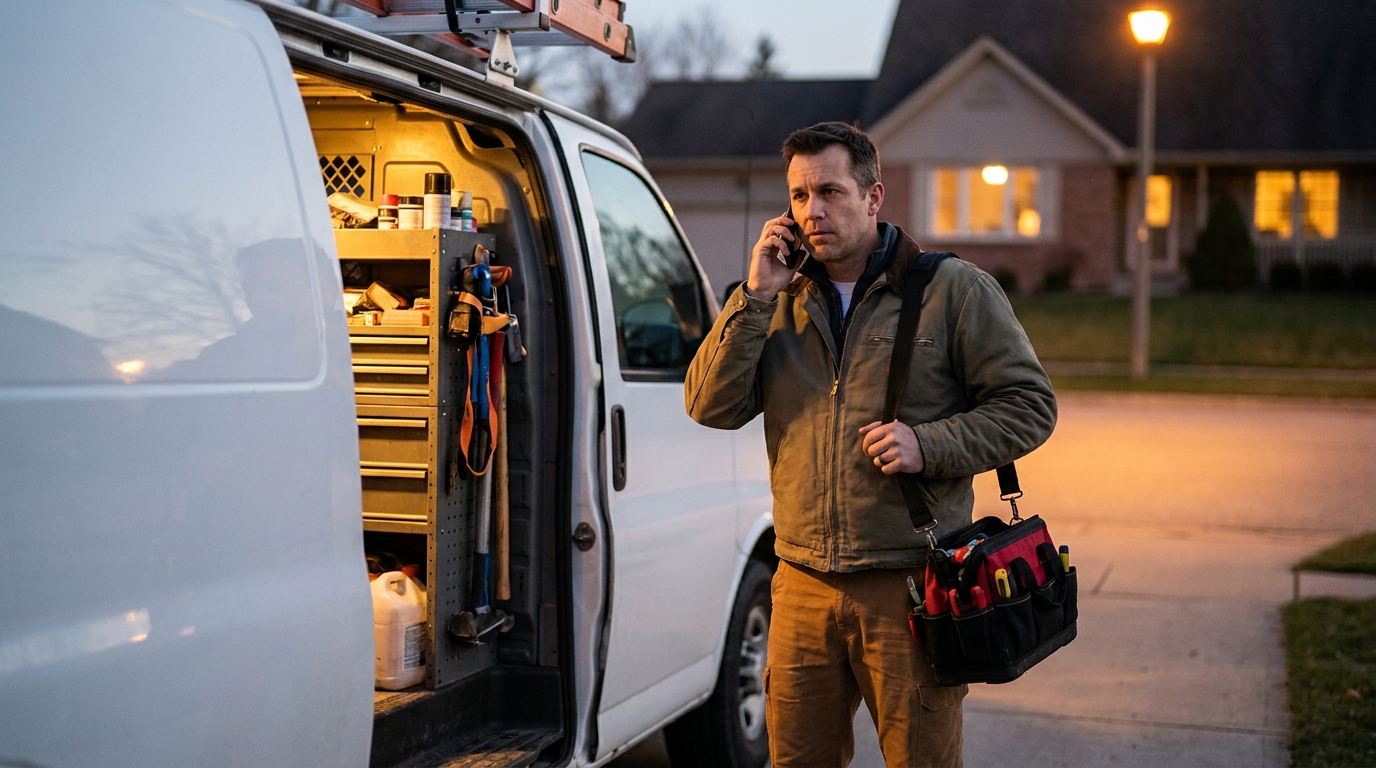
TL;DR: A live answering service for a small business costs $0.75 to $1.50 per minute, which lands most owners between $100 and $1,000+ a month, and nearly every plan ends the call the same way: with a message. That worked in 2015. In 2026, 62% of small business calls already go unanswered and 85% of missed callers never call back. This guide covers real pricing, the hidden fees, and how to buy call coverage that books jobs instead of taking notes.
Here is the stat that should end every “do I really need an answering service” debate: 62% of phone calls to small businesses go unanswered. Not after hours. Overall. And 85% of the callers you miss will not call back. They dial the next name on Google.
An answering service is the obvious fix, and the industry knows it. Entry plans start under $100 a month, and every provider promises a friendly voice on every call. But most of what you can buy under that label still ends every call the way it did in 1995: with a message. For a law office, a message is fine. For a business that rolls trucks, a message is a lead cooling off while a competitor picks up on the first ring.
I built RestorationAI.io after my uncle, a restoration contractor, lost an $80,000 condominium job to one missed call, so yes, I am biased toward answering every ring. This post is part of our complete guide to the AI receptionist for small business. Here is what answering services cost in 2026, where they earn their fee, and where they quietly fail.
What is an answering service for small business?
An answering service for small business is a third-party team, human or AI, that picks up your business line when you cannot and handles the call to your instructions: taking a message, answering common questions, booking an appointment, or escalating an emergency. You keep your number. Calls forward to the service when you are busy, after hours, or around the clock.
Four different products get sold under that one label:
- Live answering service. Remote operators answer in your company name, take a message, and relay it by text or email. Billing is per minute.
- Virtual receptionist. The same model with more polish: light scheduling, warm transfers, and a short FAQ script.
- Automated attendant. The “press 1 for service” menu. Cheap, and callers hate it.
- AI answering service. A software voice agent that holds a real conversation, qualifies the caller, books the work, and on field-service platforms, dispatches a technician.
The label on the box matters less than the last five seconds of the call. Does the caller hang up with a booked job, or with a promise that someone will call them back?
How much does a small business answering service cost?
A live answering service costs about $0.75 to $1.50 per minute, which puts most small businesses between $100 and $1,000+ per month depending on call volume. AI answering services run $50 to $300 per month, and field-service AI platforms with dispatch and CRM write-back run $297 to $597 per month.
Here is the 2026 market side by side:
| Option | Typical 2026 cost | How it bills |
|---|---|---|
| Live answering service | $0.75 to $1.50 per minute | Per minute, plus overages |
| Virtual receptionist (Ruby, Abby) | $250 to $1,725 per month | Minute bundles |
| Per-call plans (Smith.ai) | About $9.75 per call | Per call |
| Generic AI answering service | $50 to $300 per month | Flat or per minute |
| Field-service AI platform | $297 to $597 per month | Flat monthly |
| In-house receptionist | About $41,700 per year | Salary, one shift, five days |
Now read the fine print, because the advertised number is rarely the invoice. Common add-ons include call recording at $10 to $30 a month, lead qualification at a 15 to 25% rate increase, script setup at $50 to $150, and appointment scheduling at $20 to $50 a month. Overage minutes can run $1.75 to nearly $3 each. A four-minute emergency intake on per-minute billing is a $6 call before qualification fees, and it still ends in a message.
For transparency, here is where we sit: our Leakproof plan is $297 a month for 24/7 answering and lead qualification, and Rapid Response at $597 adds dispatch, work authorizations, visual intake, and route-aware booking. No contracts, no setup fees.
Whatever you pick, the monthly fee is the wrong number to optimize. The right number is cost per booked job, and I walked through that math line by line in our answering service versus AI breakdown.
What should a small business look for in an answering service?
Judge any answering service on what it does after “hello”: can it answer real questions, book real work, and reach a real decision fast, at any hour, without stacking fees? Price matters less than outcomes. Here is the checklist I give owners:
- True 24/7 coverage. Not an after-hours tier that costs extra. Nights and weekends are where the money leaks.
- Billing that fits your call length. Per-minute plans punish businesses whose intake calls run long. Emergency intakes run long.
- Your script, not theirs. The service should ask your qualifying questions: what happened, where, how urgent, who owns the property.
- Booking and dispatch, not messages. More on this below. It is the single biggest separator.
- CRM write-back. The lead should land in your job software automatically, not in your text messages.
- Surge capacity. Ask what happens when 15 calls hit at once. Watch how they answer.
- Recordings and transcripts. If you cannot audit the calls, you cannot trust the summaries.
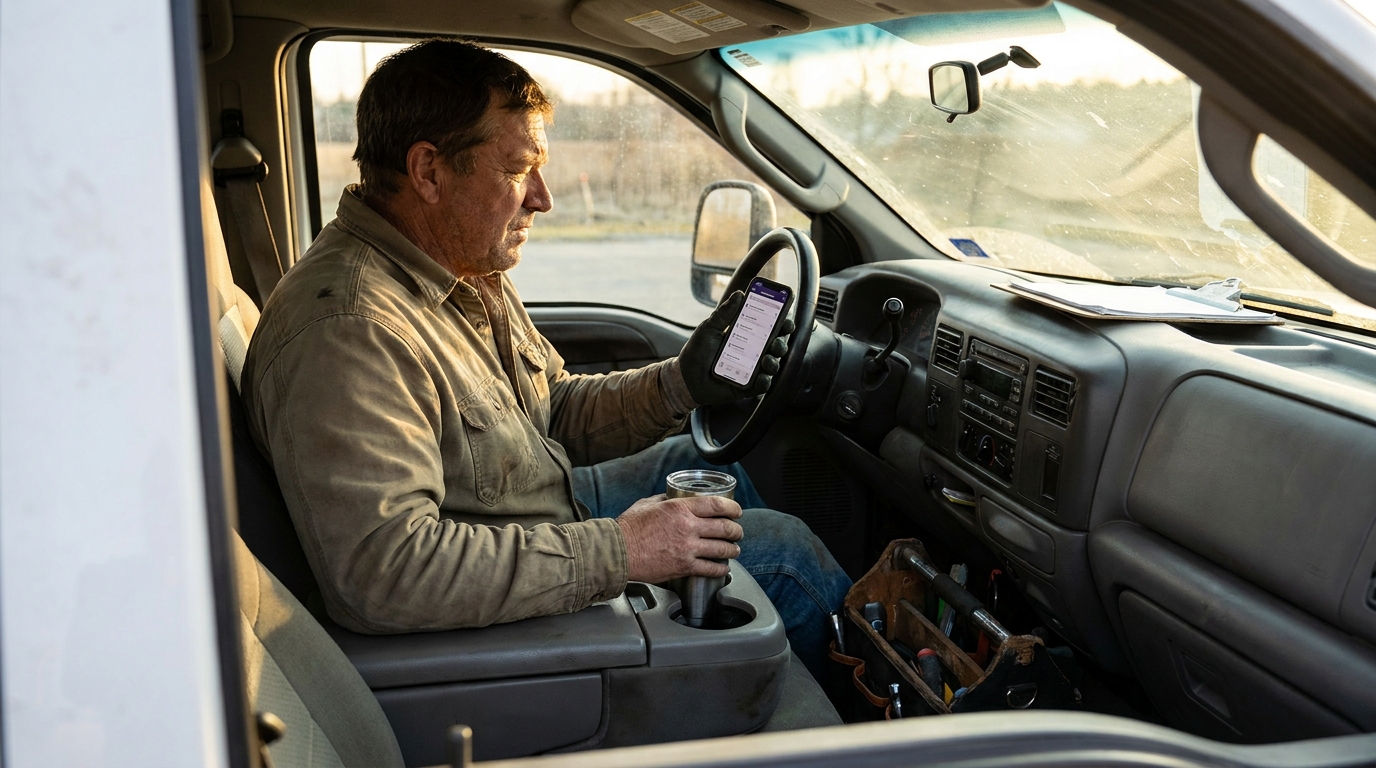 The audit that matters: calls in, calls answered, jobs booked. Everything else is decoration.
I keep a longer scoring rubric, aimed at the software side of the market, in our AI receptionist software buyer’s guide.
Is an AI answering service better than a live answering service for a small business?
For most field-service small businesses, yes: an AI answering service answers on the first ring at any hour, handles every caller at once during surge weeks, and costs a flat fee, while a live service queues callers and bills by the minute. Live operators still win for the caller who refuses to talk to software, and a good AI hands those callers off instead of fighting them.
Even the mainstream rankings have conceded the direction. Forbes Advisor’s 2026 review of answering services notes the industry’s shift from human-only models to AI and hybrid approaches. The reason is math, not fashion:
| Live answering service | AI answering service | |
|---|---|---|
| Answer speed | Queues at peak times | First ring, every time |
| Concurrent calls | Limited by staffed seats | Effectively unlimited |
| After-hours coverage | Often an extra tier | Included |
| Typical call outcome | Message relayed | Job booked, tech dispatched |
| Billing | Per minute, plus overages | Flat monthly |
| Script consistency | Varies by operator | Identical every call |
Speed is the quiet killer in that table. Conversion rates are 8x higher when a lead is engaged in the first five minutes, yet only 0.1% of inbound leads actually get engaged that fast. And callers do not wait politely in queues: about 60% of callers put on hold hang up within the first minute. A live service that answers in 45 seconds and relays a message at 8 AM is better than voicemail, but it is not speed-to-lead. I ran this comparison for the trades specifically in our guide to the answering service for contractors.
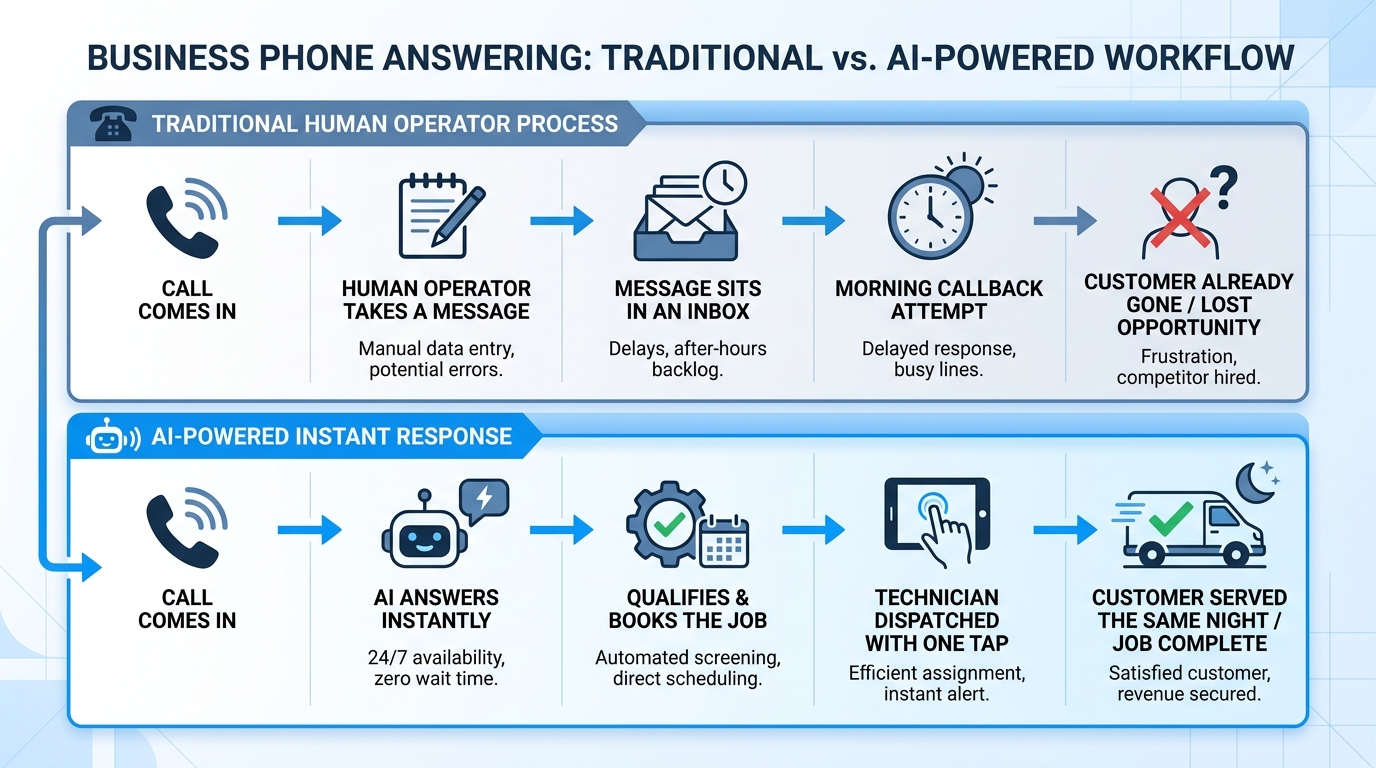 Two ways the same 9 PM call can end: a note in someone’s inbox, or a booked job with a tech en route.
Can an answering service book jobs and dispatch, not just take messages?
Most cannot. A traditional answering service takes a message and relays it. A virtual receptionist can put an appointment on a shared calendar. Only a dispatch-capable AI platform can qualify the emergency, page your on-call tech until someone accepts the job, and write the work order into your CRM while the caller is still on the line.
That gap is the entire reason this product category needed reinventing for field businesses.
In six years on restoration trucks, and 200+ contractor deployments since, I have never seen a service business lose a job because a message was written down wrong. They lose jobs because the message sat in a queue while the customer kept dialing. Buy the dispatch, not the notepad.
Here is what dispatch-capable looks like in practice. The AI runs your intake, then pushes an instant notification to your on-call tech, who accepts with one tap. If nobody responds, it cascades down your priority list until someone takes the job. It can send the customer a digital work authorization to sign before the truck arrives, and the intake data flows over webhooks into JobNimbus, Housecall Pro, Jobber, ServiceTitan, or whatever your crews already live in.
In my years on the truck, the after-hours jobs we lost never died at the phone. They died on a sticky note by the office coffee maker, six hours after the caller had already hired someone else. The handoff, not the greeting, is where answering services break.
What happens to your calls after hours and during surge weeks?
Most of your revenue calls arrive when nobody is at a desk: 73% of calls to home service businesses come in outside traditional 9-to-5 hours, and fewer than 3% of callers sent to voicemail leave a message. Whatever coverage you buy has to treat nights, weekends, and surge days as the main event, not an add-on.
The dollar figures make the point better than I can. Invoca’s data puts the average revenue lost per missed home-services call at $1,200, and past $3,500 for HVAC replacement calls. Now stack that against surge behavior: the heat wave, the cold snap, and the storm all spike your call volume on exactly the day every other company’s line is also ringing. A live service staffed for Tuesday-normal queues those calls. Each caller who hits hold music is a $1,200 decision with a 60-second fuse.
This is the one place I will tell you a cheap plan is expensive. If you only fix one coverage gap this year, fix the one between 5 PM and 8 AM. We wrote a full breakdown of that specific problem in our after-hours answering service guide, including what an emergency call should trigger instead of a morning callback.
How do you set this up without betting the business on it?
Forwarding your calls to an answering service, live or AI, is a reversible decision you can test in a week: there is no hardware, no new number, and turning it off is a call-forwarding code. That reversibility is the most underrated feature in this market. Hiring a receptionist is a $40,000+ commitment you unwind slowly. A forwarding code you can cancel is not.
Our version of setup takes three steps: sign up or book a call (free to start, no credit card), one onboarding call where a rep loads your services, pricing, and routing rules, then forward your line. The AI answers 24/7 from that moment, and today it answers 1,600+ calls a day for service businesses across the country.
So run the test that roundup articles never run. Pull last month’s phone log and count three numbers: calls in, calls answered live, and jobs booked. If the gap between the first two numbers is bigger than zero, book a strategy call at restorationai.io and bring your worst 9 PM emergency scenario. We will show you the intake, the dispatch ping, and the job card in your CRM, timestamps included. Then compare that to a message.