July 9, 2026
Answering Service for Contractors: The Real Cost Per Booked Job
What a contractor answering service costs in 2026, why per-minute billing hides the real number, and when an AI receptionist wins on cost per booked job.
TL;DR: A contractor answering service runs $0.75 to $1.50 per minute, or roughly $5 to $12 per call, and most of them take messages instead of booking jobs. The number that actually matters is cost per booked job, and on that number a live service loses badly to an AI receptionist that answers every call, qualifies the lead, and dispatches your tech. Here is the honest math.
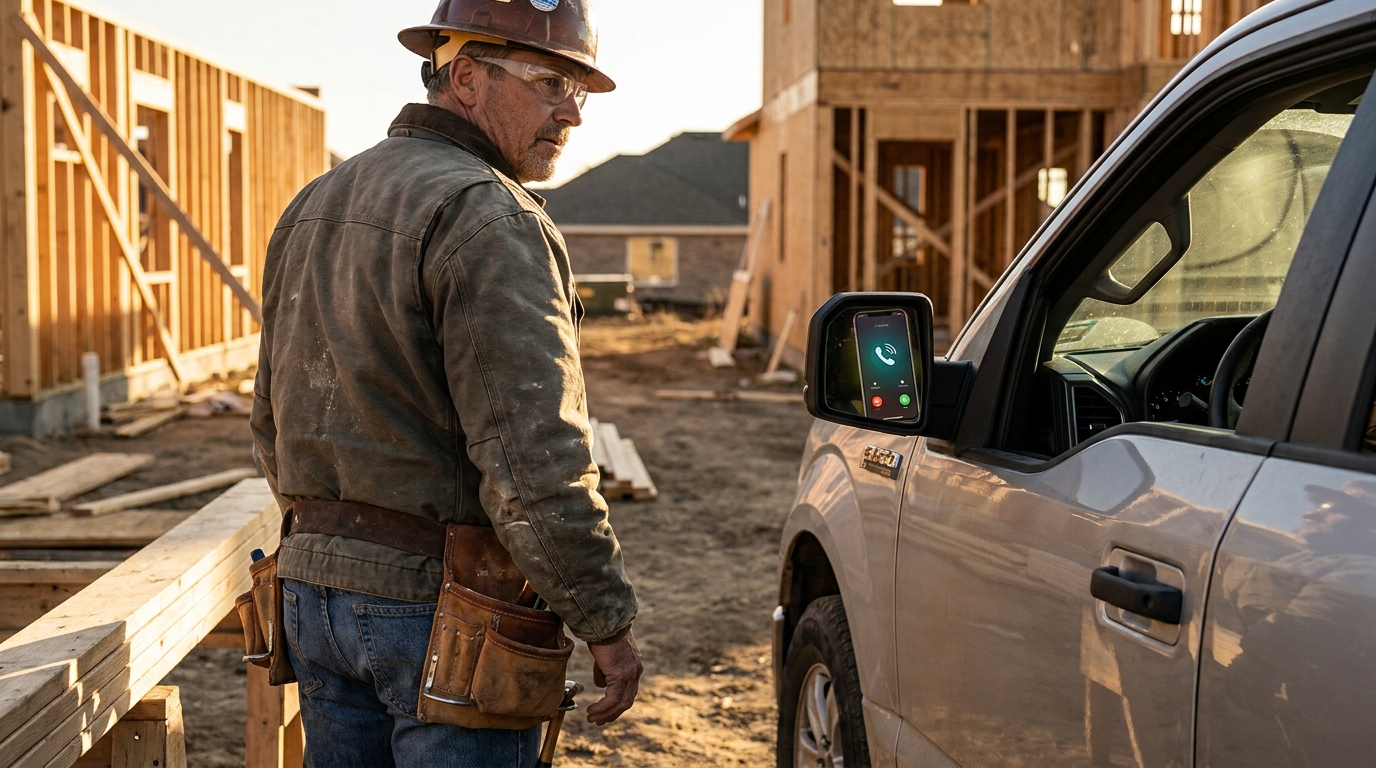
You cannot swing a hammer and answer a phone at the same time. That is the whole reason contractor answering services exist, and it is why contractors miss around 28% of their inbound calls: you are on a roof, in a crawlspace, or driving between jobs when the phone rings.
So you pay a service to answer for you. The question nobody in the answering service industry wants you to ask is what you are actually buying. Most services bill by the minute, take a message, and relay it. The caller who needed a contractor today gets a callback tomorrow, and by then the job is gone.
I care about this problem for personal reasons: my uncle, a restoration contractor, lost an $80,000 condominium job to a single missed call, and that is why I built RestorationAI.io. In this guide I will break down what a contractor answering service really costs, what it can and cannot do, and when an AI receptionist beats it outright.
What is the best answering service for contractors?
The best answering service for contractors is the one that books jobs instead of taking messages: it answers 24/7, asks trade-specific qualifying questions, dispatches your on-call tech while the caller is still on the line, and writes the job into your CRM. Most live services fail that bar, because they are built to relay messages, not to run your front office.
The market splits into two very different products that get sold under the same name:
- Message relays. A human agent answers with your company name, takes down the caller’s information, and sends you a text or email. Entry plans start cheap, some as low as $39 per month, and this is what most of the industry sells.
- Dispatch-capable services. The agent (or the AI) qualifies the lead, checks availability, books the appointment, and pushes the job into ServiceTitan, Housecall Pro, Jobber, or your restoration CRM. This is the product that actually makes you money, and far fewer vendors deliver it.
Every “best answering service” roundup ranks vendors on price, friendliness, and hold time. Almost none of them score the only outcome you care about: did the caller become a booked job on your schedule without you touching the phone. I built a full scoring checklist for that in our AI receptionist software buyer’s guide, and it applies word for word to live services too.
How much does a contractor answering service cost?
A contractor answering service costs $0.75 to $1.50 per minute on typical live plans, which works out to roughly $5 to $12 per handled call, with most home service businesses paying between $95 and $450 per month before overages.
Here is the full 2026 pricing picture:
| Billing model | Typical 2026 rate | Watch out for |
|---|---|---|
| Per minute | $0.75 to $1.50, up to $2.00 at premium vendors | Rounding up to the next minute on every call |
| Per call | $3 to $7+ for calls with intake or dispatching | ”Complex handling” upcharges for exactly the calls you need |
| Monthly plans | $135 to $450 for most small businesses | Overage rates once you burn the included minutes |
| Hidden fees | Setup fees of $50 to $500, holiday surcharges of 1.5x to 2x | Holidays and nights are precisely when emergency calls happen |
Notice the trap built into per-minute billing: the better the agent does their job, the longer the call, and the more you pay. A thorough intake on a water loss or a storm-damaged roof takes five to eight minutes. At $1.25 a minute, that is $6 to $10 per call whether the caller was a $40,000 job or a solicitor.
For comparison, a full-time receptionist runs about $41,700 a year plus taxes and benefits, and still only covers 40 hours a week. I ran the complete three-way cost comparison, including where the $2.32 per call AI number comes from, in our restoration answering service versus AI breakdown.
Can an answering service actually qualify and dispatch contractor leads?
Most live answering services cannot truly qualify and dispatch contractor leads: agents work from generic scripts across dozens of client accounts, so they take down a name and number, mark the call urgent or not, and relay the message. Real qualification (scoping the damage, checking authority to hire, paging your on-call tech until someone accepts) is rare and billed as premium handling.
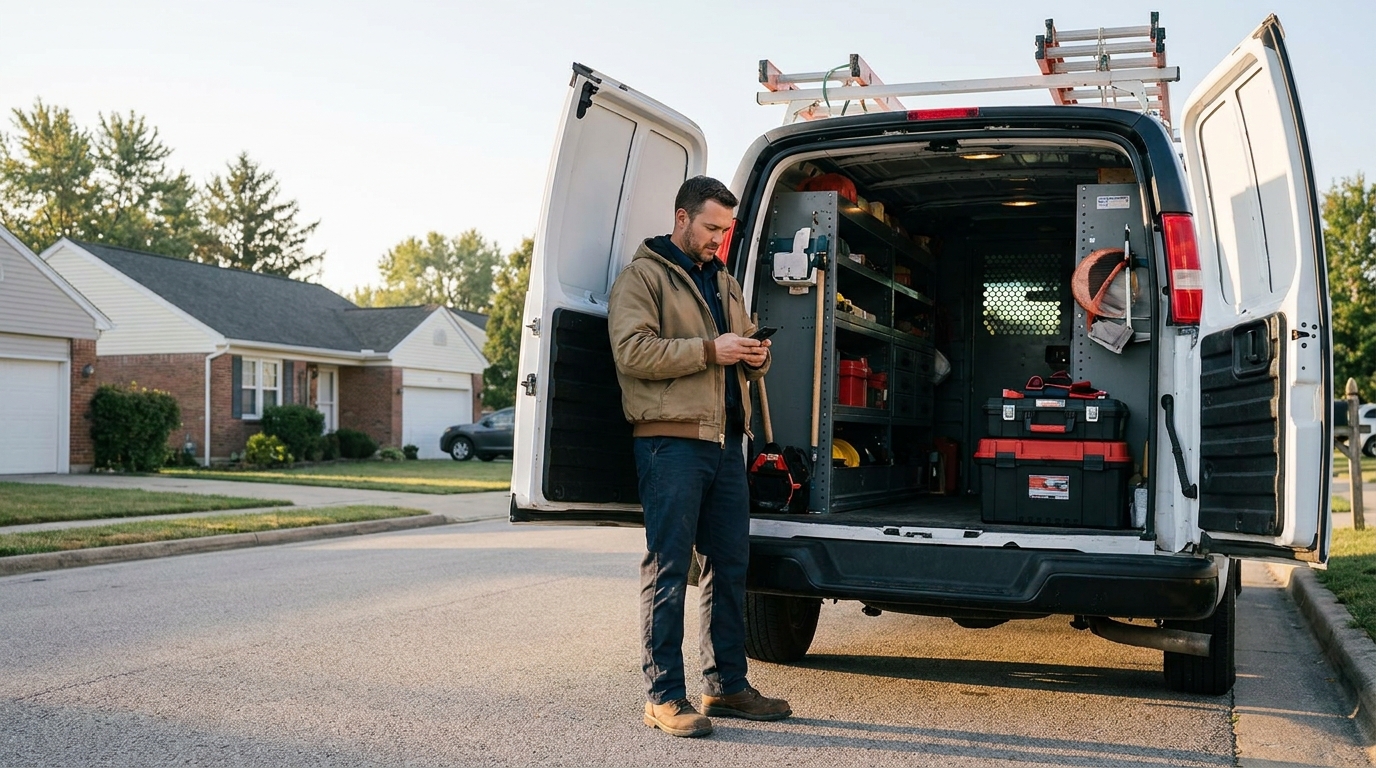 The test that matters: does your tech’s phone buzz with full job details while the caller is still on the line?
This gap matters because speed decides who wins the job. Responding to a lead within five minutes makes you 100 times more likely to reach them and 21 times more likely to qualify them than waiting 30 minutes, and 78% of customers hire the first business that responds. Yet only 12% of contractors respond to leads within five minutes, based on Hatch’s analysis of over 132,000 contractor lead campaigns.
A message relay does not fix that. It just moves the delay: the service answers in 20 seconds, then your lead sits in a text thread until you climb off the ladder.
In my six years as a restoration tech, the pattern never changed: the message the answering service relayed at 7 a.m. was usually for a homeowner who had already hired someone else at midnight. The call got answered. The job still got lost.
So when you evaluate any service, live or AI, ask three questions. Does it ask my scoping questions, not a generic script? Does it page my on-call tech and keep escalating until a human accepts? Does the job land in my CRM with the address, the damage type, and the urgency filled in? Anything less is voicemail with a salary.
What happens to a contractor answering service during a storm surge?
During a storm surge, a live answering service hits the same wall you do: a strong hailstorm can spike call volume 200% to 300% within hours, agents can only handle one call at a time, hold times stretch, and the callers who hang up dial the next contractor on Google.
This is the dirty secret of per-minute answering services: they are staffed for average volume, and storms are not average. The night a pipe-freeze event or a hail cell hits your metro is the night you get a year of revenue offered to you in six hours. It is also the night your answering service puts callers in a hold queue, and around 80% of callers who hit voicemail or give up on hold will not leave a message. They just call your competitor.
Some national services staff up for CAT events, and they charge accordingly: surge staffing is exactly what those 1.5x to 2x holiday and after-hours surcharges pay for. You are paying premium rates for capacity that still tops out at however many agents are awake.
Software does not have that ceiling. An AI receptionist answers call number one and call number forty at the same second, at 2 p.m. or 2 a.m., at the same per-call cost. Nights and weekends are where this shows up first, which is why I wrote a separate deep-dive on the after-hours answering service problem: the biggest emergency jobs almost never happen during business hours.
Answering service vs AI receptionist for contractors: which wins?
An AI receptionist beats a live answering service for contractors on cost, surge capacity, and follow-through: it answers unlimited simultaneous calls at roughly $2.32 per call versus $8 to $14 for a live service, and instead of relaying a message it qualifies the caller, dispatches your tech, and writes the job into your CRM before the caller hangs up.
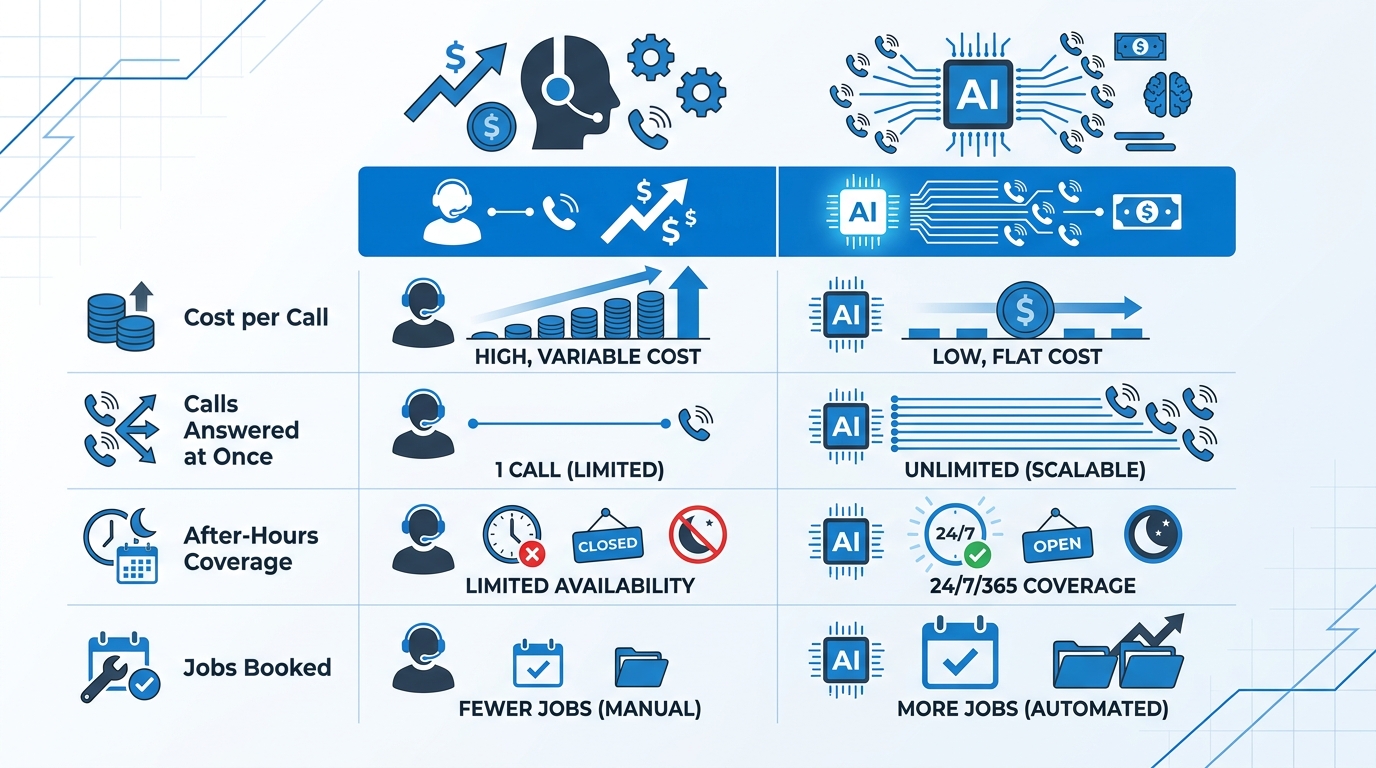 One agent, one call at a time versus software with no concurrency limit: the storm-night difference.
But the per-call price is not the real story. The real story is what each option costs you per booked job.
Run the only number that matters: cost per booked job. A live service at $8 to $14 per call, converting around 40% of qualified callers into booked work, costs you $20 to $35 for every job that actually lands on your schedule. Our AI answers the same call for about $2.32 and converts over 70% of qualified callers, which puts the cost per booked job near $3. And that math still ignores the surge calls the live service never picked up at all, which is where the five-figure jobs live.
Where does a live service still win? Genuinely unusual calls. A confused elderly caller with a complicated billing dispute, a commercial client negotiating contract terms, a situation that needs judgment and empathy beyond intake. If those are most of your calls, keep humans on them. But walk your call log: for a working contractor, 90% of inbound calls are some version of “something broke, can you come, what will it cost,” and that is a triage-and-dispatch problem software now handles better, faster, and in Spanish too.
For the full picture of how AI intake works on a real emergency call, from first ring to signed work authorization, read our guide on how an AI answering service captures every restoration lead.
How do you switch from an answering service to an AI receptionist?
Switching from an answering service to an AI receptionist takes one onboarding call and a call-forwarding change: you keep your existing phone number, configure your services, pricing, service area, and on-call dispatch order, and the AI is answering live within about 48 hours. No new hardware, no contract, and your old service can run in parallel until you trust the new one.
Here is the switch, step by step:
- Map your call types. List your services, your service area zip codes, and the jobs you do not take. This becomes the AI’s qualification logic, including politely ending solicitor and out-of-area calls in seconds.
- Set the dispatch order. Who gets paged first for an emergency, who is the backup, and how the escalation cascades until someone accepts. A summary email at 8 a.m. is not dispatch.
- Connect the CRM. Intake data should land in JobNimbus, ServiceTitan, Housecall Pro, Jobber, or whatever you run, as a job with real fields, while the caller is still on the line.
- Forward the line and test it. Call your own number. Be a messy caller, interrupt, change your story, present a fake emergency, and then check that the job card and the dispatch ping both showed up with timestamps.
- Cancel the per-minute bill. Once the AI has run alongside your old service for a week or two and captured everything, the last step is the most satisfying one.
At RestorationAI.io, our Leakproof plan is $297 a month for 24/7 answering and qualification, and Rapid Response at $597 adds live dispatch, work authorizations, visual intake, and route-aware booking. No contracts, no setup fees, and unlimited concurrent calls on storm nights.
If you want to see your own worst-case call handled end to end, book a strategy call at restorationai.io and bring the messiest emergency scenario you have. We will show you the job card, the dispatch notification, and the timestamps.