August 14, 2026
Property Management Answering Service: Triage Is the Real Product
Property management answering service costs, triage rules, and vendor dispatch. See why AI handles the 2am burst pipe and queues the dripping faucet.
Part of our guide: AI receptionist for small business
TL;DR
A property management answering service answers tenant calls 24/7, separates real emergencies from routine requests, and gets the right people moving on each. That triage is the entire product. Most services skip it: they take the same message for a burst pipe as for a dripping faucet. An AI answering service triages the call, dispatches your on-call vendor for the 2am emergency, and queues the routine request for morning, without waking you for either.
Tenant calls split into two streams. Routine requests that can wait until morning, and 2am emergencies (burst pipe, no heat in January) that absolutely cannot. The numbers say the split matters more than most managers realize: 67% of maintenance emergencies happen outside standard business hours. Your office phone is closed for the exact calls that do the most damage.
Most answering services treat both streams the same. Either every call wakes you at 2am, or every call, including the emergency, sits in a message queue until 8am. Both failure modes cost you. One burns out your team. The other turns a contained leak into a three-unit insurance claim.
This is part of our complete guide on AI receptionist for small business.
I built RestorationAI.io after my uncle lost an $80,000 job to a single missed call, and before that I spent six years as a restoration technician walking into the damage that late-answered calls cause. Here is what a property management answering service costs, how triage should actually work, and how to get emergencies dispatched without answering your own phone at 2am.
What is a property management answering service?
A property management answering service is a 24/7 phone service, staffed by live operators or AI, that answers tenant and owner calls when your office cannot, logs maintenance requests, and escalates emergencies to the right person. The good ones do more than take messages: they triage every call and dispatch a vendor when the problem cannot wait.
There are two kinds. The first is a traditional live call center, where shared operators answer for hundreds of businesses at once. Most were built for law firms and medical offices, so they are good at capturing a name and a number and not much else. Operator turnover at these call centers runs 30 to 45% a year, so intake quality drifts with whoever picked up. The second kind is an AI answering service that picks up instantly, asks the triage questions the same way every time, and can create the work order and dispatch on its own.
The timing data explains why this matters. Only about 55% of tenant calls come in during business hours. The rest land on evenings, nights, and weekends, and the overnight slice is the dangerous one: roughly 35% of late-night calls are genuine emergencies, against about 3% during the day. The calls your office never sees are the ones most likely to be real.
A real service captures what the fix requires: tenant name and unit, callback number, the problem in plain words, whether water is flowing right now, whether there is heat, any smell of gas, and whether the tenant can reach a shutoff. That intake is the difference between a work order and a sticky note.
How much does a property management answering service cost?
A property management answering service costs about $200 to $800 per month for most portfolios. Live services bill $0.75 to $1.50 per minute or $1.50 to $4.00 per call, often with setup fees of $50 to $500. AI answering services charge a flat monthly rate, typically $200 to $400, with no per-minute meter.
The pricing models break down like this:
- Per-minute billing. Roughly $0.75 to $1.50 per minute. Tenant calls run long (upset callers, step-by-step instructions, callbacks), so the meter punishes exactly the calls you most need handled well.
- Per-call billing. About $1.50 to $4.00 per call. A noise complaint costs you the same as a flooded unit, and high-volume weeks blow up the invoice.
- Monthly packages and per-unit plans. Packages start around $200 to $500 with overage charges, and specialized property management plans run $1 to $3 per unit per month. On a 300-door book, per-unit pricing adds up fast before a single emergency is handled.
- AI flat rate. A fixed monthly fee with unlimited calls. Our own plans start at $297 per month for 24/7 answering, which pencils out to around $2.32 per call at mid volume.
The sticker price is the wrong number to shop on. What matters is cost per resolved emergency and cost per booked work order, which is why I published the real per-call arithmetic in our virtual receptionist pricing guide. A service that is $100 cheaper per month but batches your 2am burst pipe to morning is not cheaper.
How should an answering service triage tenant maintenance calls?
An answering service should sort every tenant call into one of two buckets while the tenant is still on the line: dispatch now (active water, no heat in freezing weather, gas smell, sewage backup, sparking electrical) or morning queue (dripping faucet, dead appliance, noise, routine repairs). Everything else the service does is plumbing around that one decision.
The two-bucket rule is not just operational, it is legal. Most states require landlords to act on true emergencies like a burst pipe or no heat the same day, with 24 to 72 hours for less urgent habitability issues. A service that files a burst pipe as a morning message is filing evidence that you knew and waited.
In my six years as a restoration tech, the 2am calls we ran for property managers were never really about the pipe. The pipe is a $500 fix. The difference between a tenant who reached someone at 2:05am and a tenant who gave up until morning was the difference between drying one bathroom and gutting the drywall in three units.
Good triage sounds like a short checklist, asked the same way on every call: Is water flowing right now? Can you find the shutoff valve? Is anyone in danger? Do you have heat? What floor are you on? A message-taker asks for a name and number. A triage service walks the tenant to the shutoff while it dispatches the plumber. An AI does not get tired of the checklist, and it handles the tenth call of the night exactly like the first.
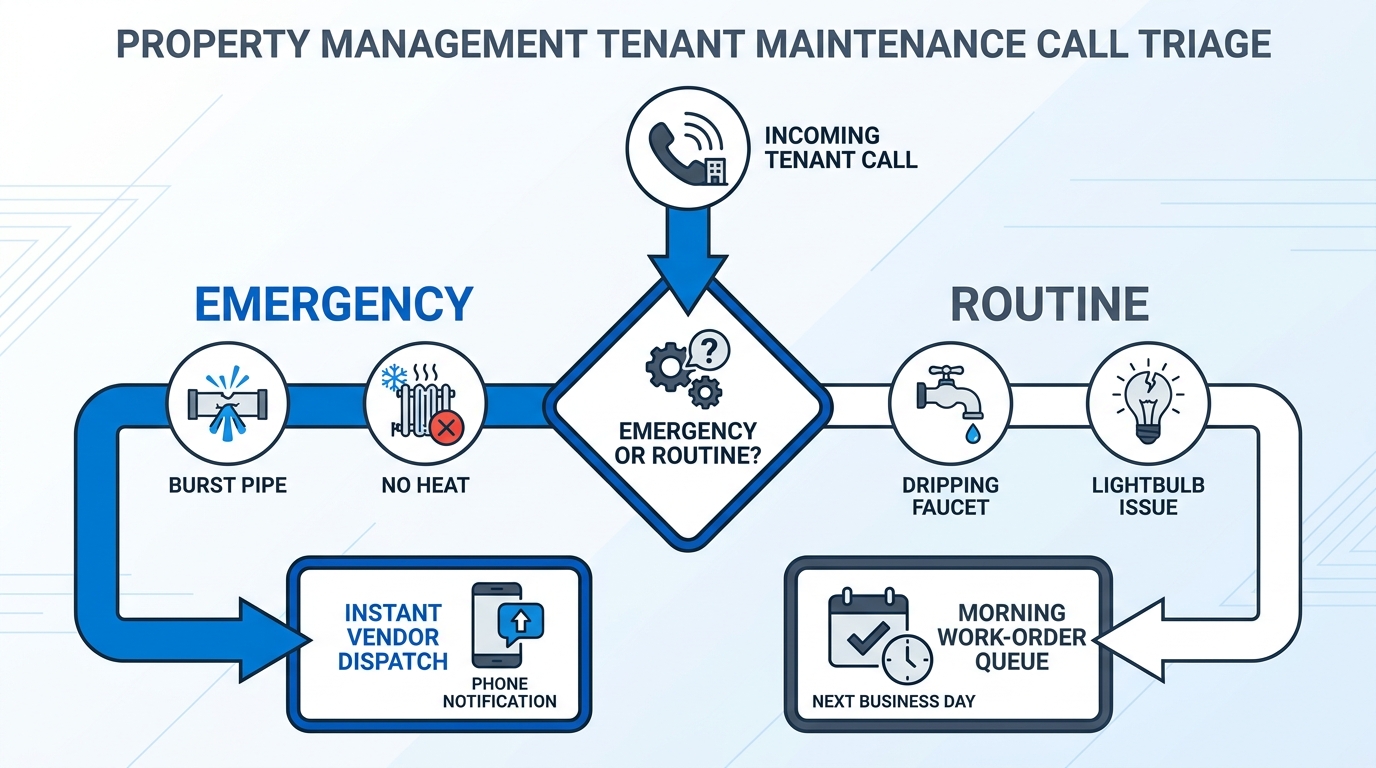 The whole product in one decision: dispatch now, or queue for morning.
What happens to property management calls after hours?
After hours, most property management calls go to voicemail, an on-call cell phone, or a message-taking service, and each option fails in its own way. That gap is wide: 45% of tenant calls land outside business hours, and the overnight window carries the highest share of true emergencies.
The three common setups all leak:
- Your personal cell. Answer rates on a personal phone run 70 to 80% at best, and every answered call is your sleep. This works at 20 doors and breaks somewhere before 100.
- Staff rotation. Splitting on-call duty across your team costs around $1,000 a month in practice once you count comp time, and it is the reason good coordinators quit.
- A live message-taking service. It answers, but because it cannot tell a flood from a faucet, it either wakes you for everything or batches everything, emergencies included, to morning.
The fix is the same one I give every emergency-adjacent business: size your coverage for the 2am call, not the 2pm average. I wrote the full breakdown in our guide to the after-hours answering service, and the property management version is stricter, because you are the one legally on the hook for the response time.
What does a missed emergency call cost a property manager?
One missed emergency call can cost more than a decade of answering service fees. The average water damage and freezing insurance claim runs $13,954, and that is before the turnover: replacing a tenant costs $2,500 to $5,000 per unit once vacancy, make-ready, and leasing fees are counted.
Run the math on one supply line letting go at 2am. Caught at 2:05, it is a shutoff valve, a plumber, and a few fans: low four figures. Discovered at 7:40am, it is five hours of water finding every path down. Around 1 in 60 insured homes files a water damage or freezing claim every year, and I spent six years demoing out what those claims look like from the inside. The deductible, the displaced tenants, and the premium hike all land on the same desk: yours.
The slow leak is retention. Slow maintenance response is the number one tenant complaint in rental housing, ahead of rent increases. An MIT Center for Real Estate study of 104,586 tenant survey responses found a one-point satisfaction increase corresponded with an 8.6% higher likelihood of lease renewal, and 31% of residents unsure about renewing say they would stay if maintenance service improved. With average turnover at $3,872 per unit and 43% of units turning over each year, the phone is not an admin line. It is a retention tool that happens to ring.
Can an AI answering service dispatch maintenance vendors automatically?
Yes. A properly built AI answering service dispatches your on-call vendor in real time: it triages the call, fires a push notification to the right trade (plumber for the burst pipe, HVAC tech for no heat), and keeps escalating down your list until someone accepts the job.
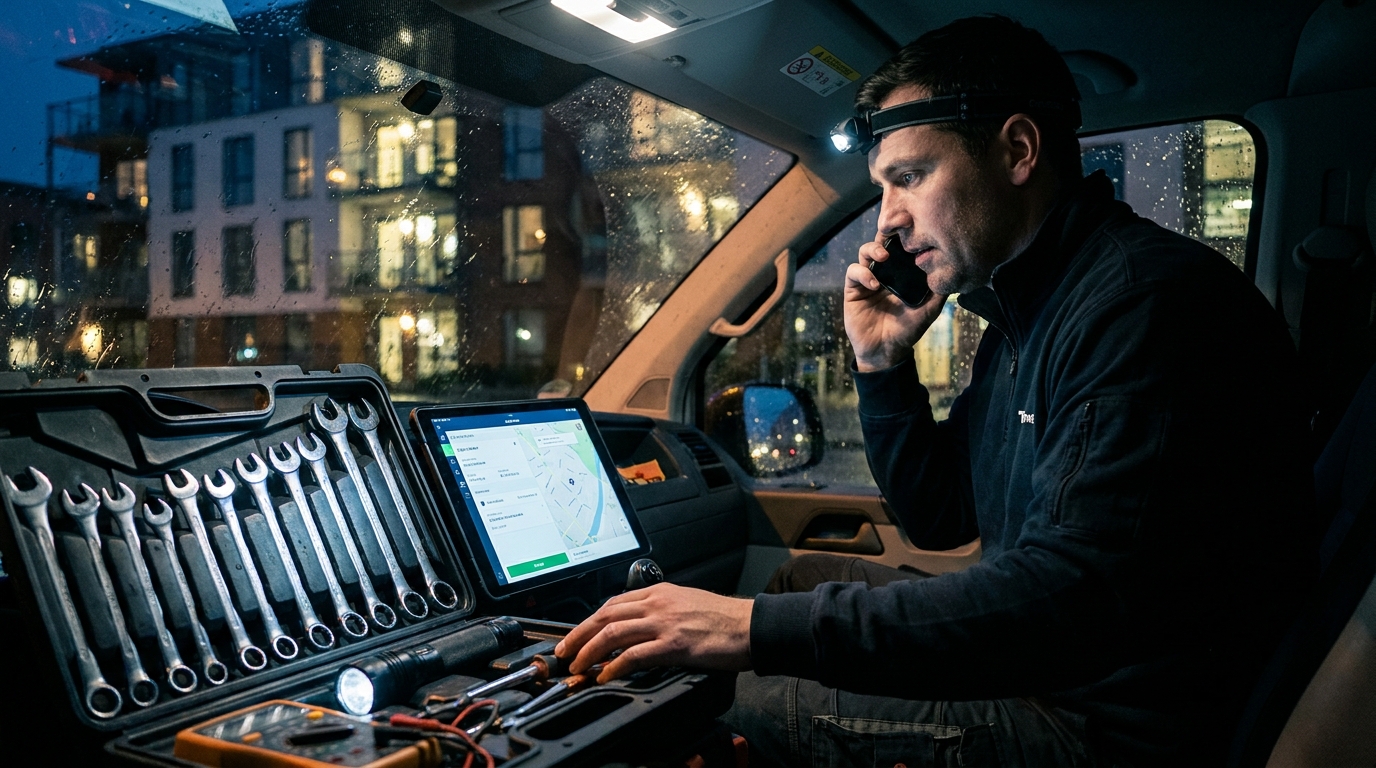 Real dispatch means your on-call vendor has the work order before the tenant hangs up.
The mechanics are what separate dispatch from message-relay. Cascade Dispatch contacts your vendors in priority order until one accepts with a single tap, so a plumber sleeping through one text never strands a flooding unit. Role-based routing sends electrical calls to the electrician and water calls to the plumber instead of sending everything to you. Visual intake texts the tenant a link to photograph the problem, so the vendor rolls with the right parts on the truck. And the job writes itself into your software before the call ends, with native connections to Housecall Pro, Jobber, and ServiceTitan.
Routine calls get the opposite treatment, which is the point. The dripping faucet is logged, tagged, and queued as a morning work order, and nobody’s phone lights up at 2am for it. Your vendors feel the difference too: this is the same dispatch standard we set in our guide to the best answering service for plumbers, because the plumber on the other end of your 2am call has the same problem you do.
| Factor | Live answering service | AI answering service |
|---|---|---|
| 2am emergency call | Message-taking skeleton crew | Full triage, identical to 2pm |
| Emergency vs routine triage | Rarely, wakes you or waits | Built in, on every call |
| Dispatches your vendor | No, leaves you a message | Yes, cascades until accepted |
| Routine requests | Same message pile | Logged and queued for morning |
| Tenant damage photos | No | Texted link, attached to the job |
| Billing | Per minute or per call | Flat monthly |
The bottom line: buy the triage, not the message pad
A property management answering service earns its fee in one moment: the 2am call where water is moving and the clock is running. Everything else is note-taking you could get from voicemail. The service you want makes one decision correctly, every time: dispatch now, or queue for morning. Get that right and your emergencies get contained, your routine requests stop costing you sleep, and your tenants renew because someone always picks up.
Setup is not a project. Forward your line, load your vendor list and properties, and you are live in 48 hours, with no contracts and no per-minute meter. If you want to see how instant triage and vendor dispatch would handle your portfolio’s actual call flow, book a strategy call with our team. We will map your after-hours gaps, your emergency exposure, and the exact calls slipping past you right now, then show you what catching every one of them is worth.