August 6, 2026
HVAC Answering Service: Why Surge Capacity Beats Price Per Call
HVAC answering service pricing, dispatch, and surge capacity compared. See why AI answers every heat-wave call that live services queue and drop.
Part of our guide: AI receptionist for small business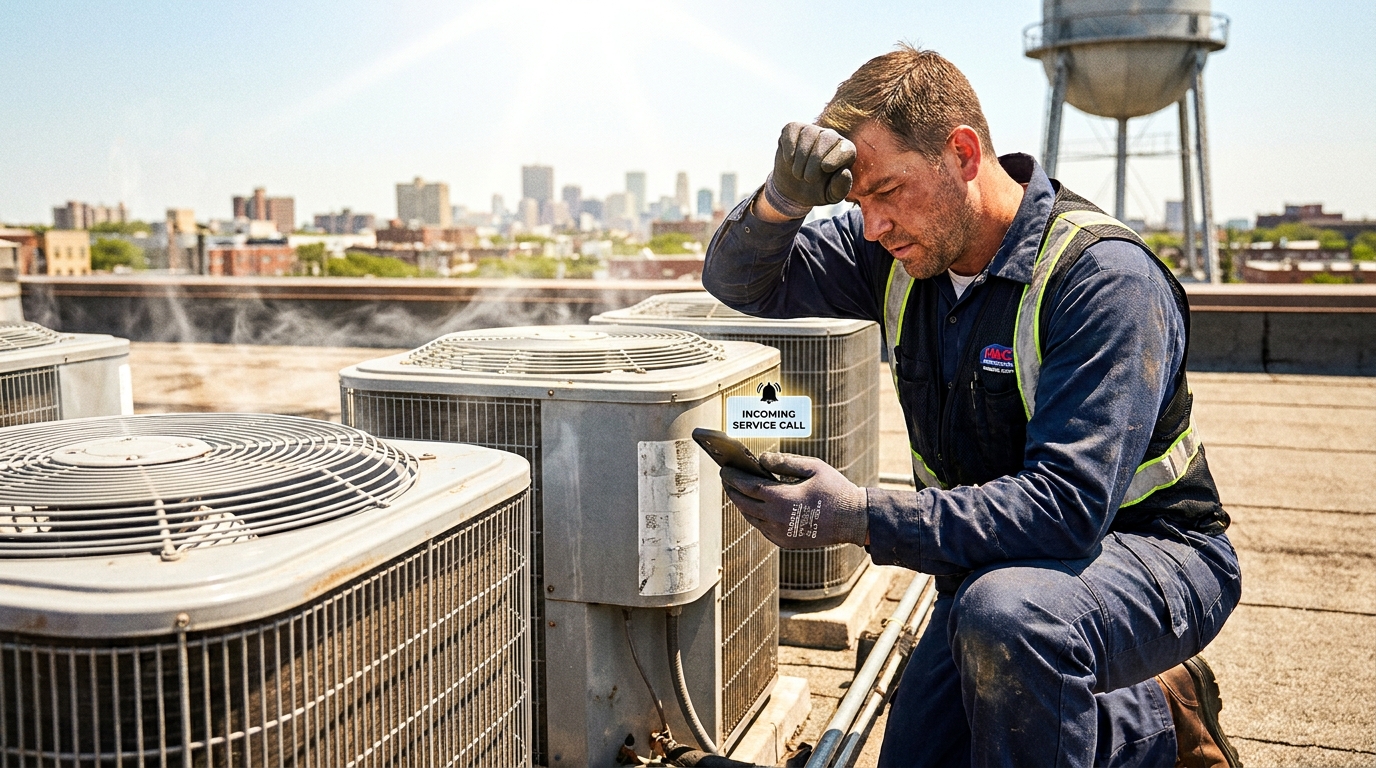
TL;DR
An HVAC answering service answers every call, triages the emergency, and dispatches a tech, even when a heat wave triples your call volume overnight. The real buying criterion is not price per minute. It is surge capacity. Live services share agents across hundreds of companies, so they queue and drop calls on the exact days you get the most business. An AI answering service answers unlimited calls at once, so you never lose a no-cool job to voicemail.
The first heat wave of the summer is the best and worst day of your year. Best, because the phone will not stop ringing. Worst, because you cannot answer half of it. When the temperature hits 100 and every air conditioner in town quits at once, summer HVAC call volume jumps around 340% over spring. Your techs are on rooftops. Your office manager is on another line. The no-cool calls keep coming.
This is part of our complete guide on AI receptionist for small business.
An HVAC answering service is supposed to catch those calls. Most do not, at least not the way you think. They take a message and promise a callback, which is useless when the customer just wants to know who can get there today. I built RestorationAI.io after my uncle lost an $80,000 job to a single missed call, and the pattern in HVAC is identical: the company that answers first wins the job. Here is what an HVAC answering service costs, what it should actually do, and the one buying criterion that matters more than price.
What is an HVAC answering service?
An HVAC answering service is a phone-answering system, staffed by live agents or AI, that picks up your calls when you cannot, gathers the customer’s problem and address, and either books the job or passes you the message. The good ones do more than take a message: they triage the emergency and dispatch a technician while the caller is still on the line.
There are two kinds. The first is a traditional live call center, where human operators answer for hundreds of businesses at once. Most of these were built for doctors’ offices and law firms, so they are good at taking a name and a number and not much else. The second is an AI answering service that answers instantly, qualifies the job, and can schedule and dispatch on its own.
The distinction matters because 62% of HVAC calls come outside regular business hours. Nights, weekends, and holidays are when the furnace dies and the AC quits. A message-taker that promises a callback “first thing in the morning” loses those jobs, because the customer keeps dialing until someone answers.
A real HVAC answering service captures what a tech needs before they roll: the address, the system type, whether it is no-cool or no-heat, how urgent it is, and whether the customer wants it booked now. That is the difference between a lead and a note.
How much does an HVAC answering service cost?
An HVAC answering service costs roughly $300 to $2,500 per month, depending on the model and your call volume. Live call-center services run about $300 to $1,500 per month at nearshore providers and $400 to $2,500 US-based, usually billed per minute or per answered call. AI answering services charge a flat monthly rate with unlimited calls.
There are three pricing models to know:
- Pay-per-call or per-minute. Roughly $1.50 to $3.00 per minute. Cheap at low volume, brutal during a surge, because your bill scales with your busiest week.
- Monthly plan with capped minutes. About $250 to $1,200 per month for a bucket of minutes, with overage fees once you blow past the cap. You always blow past the cap in July.
- AI flat-rate. A fixed monthly fee with unlimited calls and no per-minute meter. Our own plans start at $297 per month for 24/7 answering, which pencils out to around $2.32 per call at mid volume.
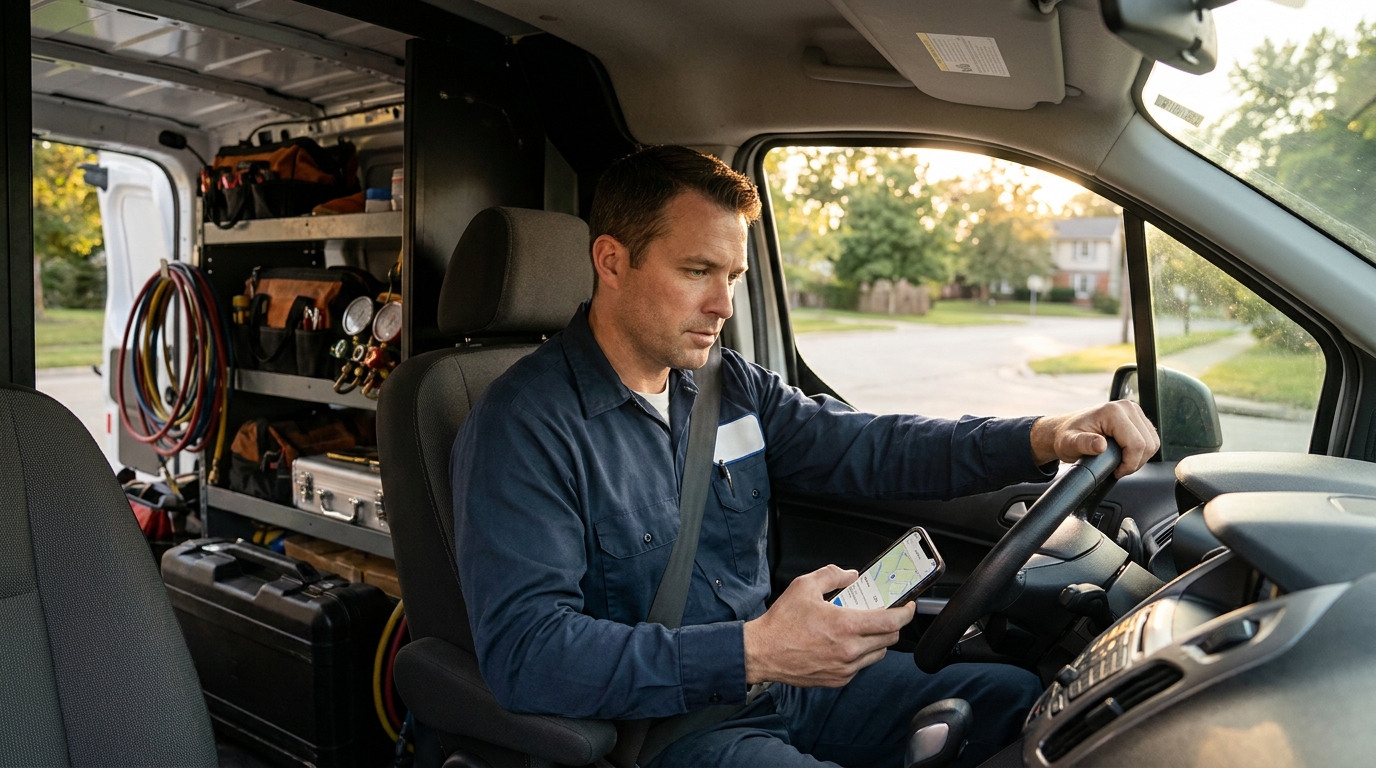 A modern HVAC answering service dispatches the job to your tech before the caller hangs up.
The number that actually matters is cost per booked job, not cost per minute. One captured no-cool repair is worth $200 to $800, and each missed call costs an HVAC contractor an average of $350 or more. A single saved emergency pays for months of service. The per-minute model hides this, which is why I built out the real cost-per-call math on virtual receptionist pricing instead of trusting the sticker price.
What happens to HVAC calls during a heat wave or cold snap?
During a heat wave or cold snap, your call volume spikes at the exact moment every live answering service is also overloaded. That is the trap. A live service shares its agents across hundreds of companies, so when a regional heat wave lights up every HVAC line at once, calls queue, hold times climb, and callers hang up. The days you get the most business are the days a live service drops the most calls.
The numbers are stark. AC repair demand jumped 266% in July during a recent summer. When the first heat wave of 2026 hit, some HVAC companies fielded hundreds of calls in a week and ran techs past 9 p.m.. And even in a normal week, 60% of after-hours HVAC calls go unanswered industry-wide. Add in that the average caller now hangs up after just 2.3 seconds, and a queue is a lost job.
In my years on the truck, the busiest weeks were never as profitable as they should have been. On a 100-degree Monday we would come back to a voicemail box full of no-cool calls that had already booked someone else. The problem was never demand. It was the capacity to answer it.
This is why surge capacity, not price per call, is the buying criterion for HVAC. An AI answering service answers an unlimited number of calls at the same time. Ten callers at 2 p.m. on the hottest day of the year all get answered on the first ring, triaged, and booked. There is no queue and no hold music. That capacity is worthless 51 weeks a year and priceless during the one week that makes your quarter, which is exactly why it is the feature to buy for. If you only take one thing from this guide, make it this: size your after-hours answering service for your worst day, not your average day.
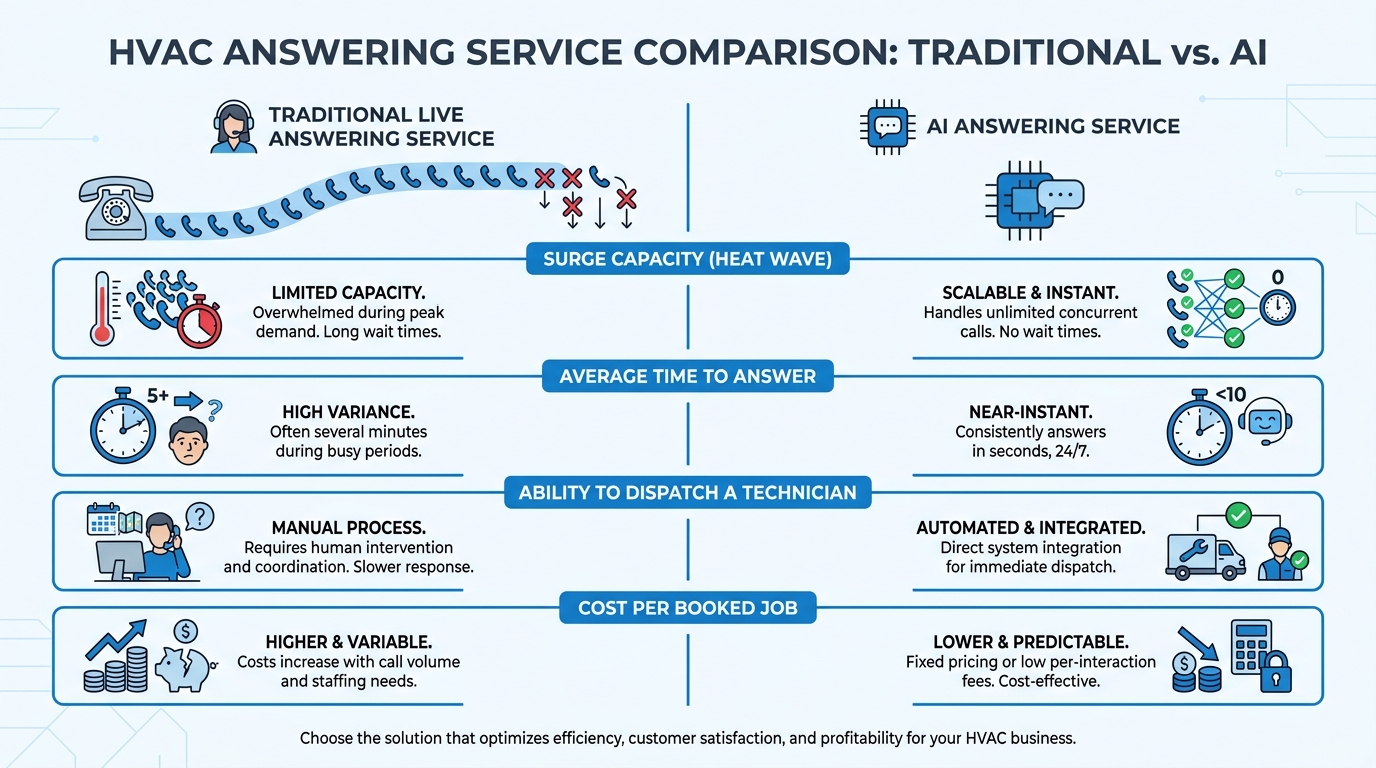 Live services queue during a heat wave; AI answers every call at once.
Can an AI answering service schedule HVAC service calls and dispatch techs?
Yes. A properly built AI answering service does more than take a message: it schedules the service call on your calendar and dispatches a technician in real time. When a no-cool call comes in, the AI gathers the address, system type, and urgency, books the appointment, and fires a notification to your on-call tech, who accepts with one tap.
The dispatch mechanics are what separate job capture from message-taking. Cascade Dispatch contacts your team in priority order until someone accepts, so a sleeping tech never means a lost call. Role-based routing sends the job to the right person, whether that is a lead installer or a service tech. And Smart Route Booking checks where your crews already are and books the new job nearby, so you fit more calls into a brutal summer day instead of burning hours in the truck.
It also writes the job straight into your software. A good AI answering service pushes the booked job into your CRM before the customer hangs up, with native support for Housecall Pro, ServiceTitan, Jobber, and others. No sticky notes, no double entry, no lead lost between the phone and the schedule. Given that the first contractor to respond wins 78% of emergency jobs, instant dispatch is not a nice-to-have. It is the whole game.
Is an AI answering service better than a live service for HVAC companies?
For HVAC, an AI answering service beats a live service on the two things that decide the job: speed to answer and surge capacity. AI answers in seconds with no queue, handles unlimited calls at once, and dispatches instantly. A live service makes sense only if you specifically want a human voice and your call volume never spikes, which for HVAC it always does.
Here is the honest comparison:
| Factor | Live answering service | AI answering service |
|---|---|---|
| Time to answer | Queues under load | Instant, first ring |
| Heat-wave capacity | Shared agents, calls drop | Unlimited concurrent calls |
| Dispatch a tech | Rarely, takes a message | Yes, in real time |
| Books the job | Sometimes | Yes, onto your calendar |
| Billing | Per minute or per call | Flat monthly, unlimited |
Live services are not useless. A human voice reassures some callers, and a slow-and-steady office phone can lean on one for overflow. But the per-minute model punishes you on your busiest days, and message-taking loses the emergency jobs worth the most. The same math holds across the emergency trades: it is why we reach the same conclusion in our guide to the best answering service for plumbers. When the whole town’s equipment fails on the same afternoon, capacity wins.
Keep in mind that contractors miss an average of 22% of calls, rising to 35% during peak season. A live service can shave that number. An AI service built for surge can take it to zero.
How do you set up an HVAC answering service?
You can set up an HVAC answering service in about five minutes: sign up, tell it your services and pricing, connect your dispatch, and forward your business line. Full configuration takes one onboarding call, and you are live 24/7 from day one.
The steps look like this:
- Sign up and load your services. Add your service list, common jobs, and pricing so the AI can quote and scope on the call.
- Connect your dispatch. Point it at your on-call tech’s phone or your team notification system so every call fires a real-time alert.
- Forward your business line. Route your main number to the service. All after-hours and overflow calls flow through automatically.
- Test and go live. Make a test call, confirm the AI answers, books, and dispatches, then leave it on.
No contracts, no setup fees, no per-minute overages. You are live in 48 hours and can adjust coverage in seconds.
The bottom line: capacity beats cost per call
The cheapest HVAC answering service is the one that captures the most jobs, not the one with the lowest per-minute rate. On a mild Tuesday, almost any option works. On the first 100-degree day of the summer, when every AC in town quits and the phone rings ten times at once, only surge capacity keeps you from bleeding jobs to voicemail. That is the day that decides your quarter, and it is the day to buy for.
If you want to see how instant answering and real-time dispatch handle your worst day instead of your average one, book a strategy call with our team. We will map your call flow, your surge windows, and the exact jobs slipping to voicemail right now, then show you what catching all of them is worth.