August 10, 2026
Bilingual Answering Service: Answer Every Caller in Their Own Language
What a bilingual answering service costs, why Spanish-speaking callers hang up on English-only lines, and how AI answers every call in any language.
Part of our guide: AI receptionist for small business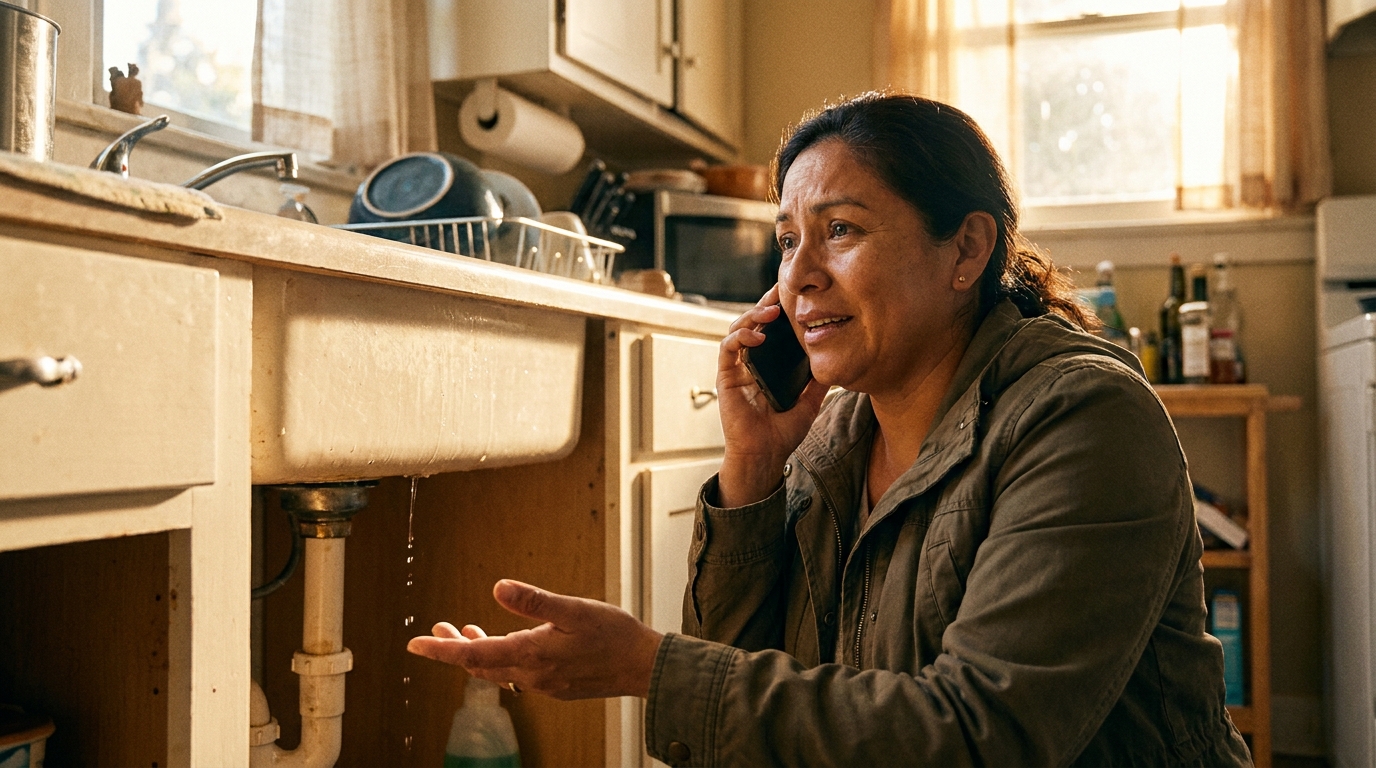
TL;DR
A bilingual answering service answers your business calls in English and Spanish so a language barrier never costs you a job. Live bilingual services charge about $1.38-$1.65 per minute and treat Spanish coverage as a staffing problem. An AI answering service treats it as a default: every call answered instantly, in the caller’s language, with the same triage and dispatch. In markets where the fastest-growing group of homeowners prefers Spanish, that difference is revenue.
Why language decides who wins the job
This is part of our complete guide on the AI receptionist for small business.
Nearly 68 million people in the US speak a language other than English at home, and Spanish leads by a wide margin at over 41 million speakers. Roughly 4 in 10 Spanish speakers report speaking English less than “very well”. Now picture one of them with a burst pipe at 9 PM. They call your number. The voice on the other end speaks only English. They do what any of us would do in their position: apologize, hang up, and dial the next company on the list.
I built Restoration AI after my uncle lost an $80,000 condo job to a single missed call. A call answered in a language the caller cannot use is the same miss wearing a different uniform. The phone rang, you technically picked up, and the job still went to your competitor. This guide covers what a bilingual answering service is, what it really costs, and why AI has quietly made the old way of buying one obsolete.
What is a bilingual answering service?
A bilingual answering service answers your business phone in two languages, almost always English and Spanish, and handles the entire call in the caller’s language: greeting, intake, booking, and message delivery. The key word is “entire.” A service that greets in Spanish and then transfers the caller to a queue for the one available Spanish operator is bilingual in name only.
Traditional providers do this with people. They hire a pool of Spanish-speaking operators, spread them across hundreds of client accounts, and route Spanish calls to whoever is free. That model works fine for a law office taking messages. It breaks down for service businesses, where the call is not a message but a job: the operator has to scope the problem, quote or qualify, book the appointment, and get a tech moving.
For an emergency trade, the test of a bilingual service is simple. Can it ask a Spanish-speaking homeowner where the water is coming from, whether it is clean or sewage, who their insurance carrier is, and then dispatch a crew? If the answer is no, the service is taking bilingual messages, not capturing bilingual jobs.
How much does a bilingual answering service cost?
Live bilingual answering services cost about $1.38 to $1.65 per minute for Spanish coverage, and the average small business pays $200 to $500 per month depending on call volume. High-volume or customized plans run $500 to $5,000 and up. AI answering services charge a flat monthly rate with no language surcharge, because adding a language costs the software nothing.
Here is how the two models compare:
| Factor | Live bilingual service | AI answering service |
|---|---|---|
| Pricing model | $1.38-$1.65 per minute | Flat monthly rate |
| Spanish coverage | Limited operator pool | Native, every call |
| Transfer wait | Queue for a free bilingual agent | None, answers in-language instantly |
| After-hours parity | Often English-only overnight | Identical 24/7 |
| Dispatch | Rarely, takes a message | Yes, in real time |
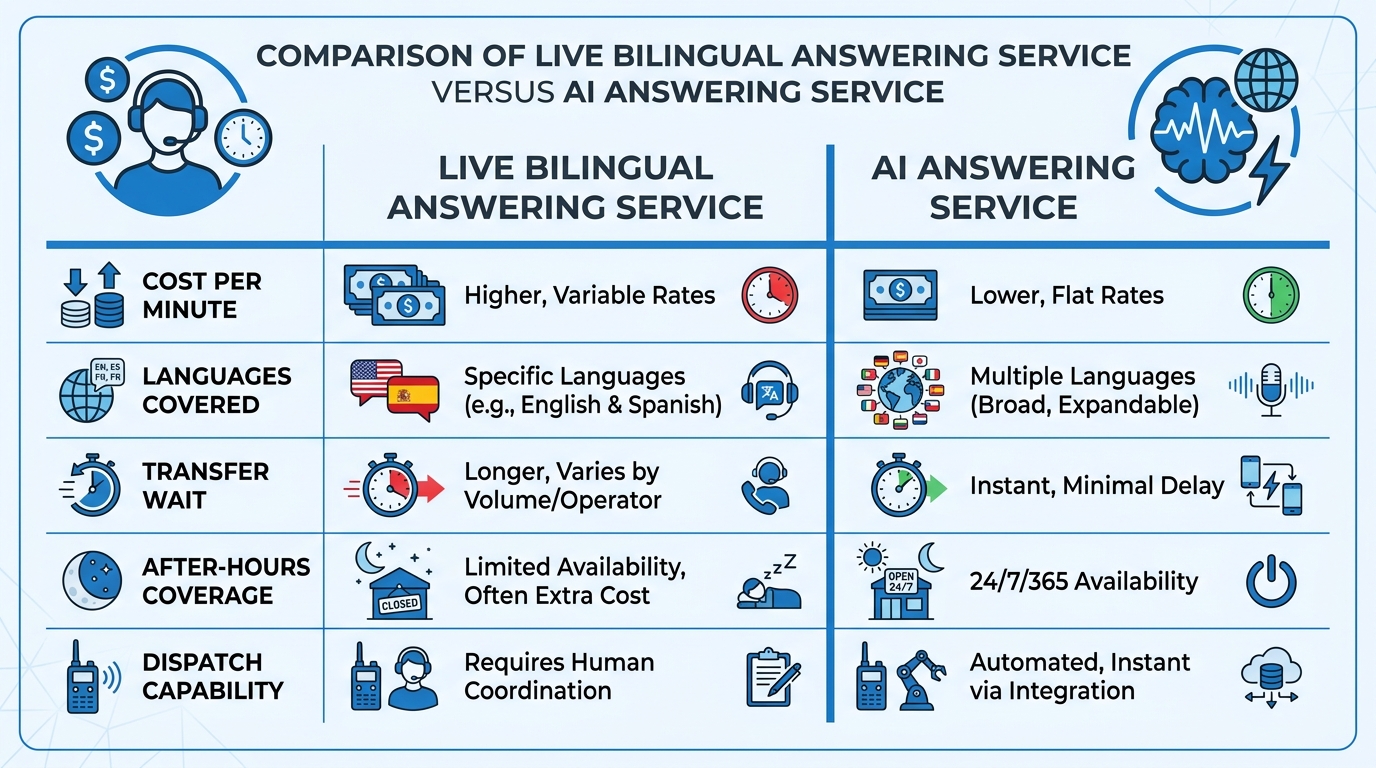
Live bilingual coverage bills by the minute; AI covers every language at a flat rate.
The per-minute math matters more than it looks. Emergency intake calls run long: a panicked homeowner describing water damage takes 8-12 minutes, and at $1.50 per minute that is $12-$18 per call before a single job books. On our platform, mid-volume customers land around $2.32 per call with full intake and dispatch included. We broke down the full per-minute arithmetic across live, virtual, and AI services in our guide to virtual receptionist pricing, and the pattern holds here: the premium you pay a live service is for scarce human hours, and bilingual human hours are the scarcest of all.
Why do Spanish-speaking callers hang up on English-only businesses?
Because they can buy from someone else in their own language, and the data says they will. CSA Research’s global survey found 76% of consumers prefer to buy with information in their own language, and 40% will never buy in another language at all. The same research found 75% are more likely to buy from a brand again when customer care is in their language. A phone call is customer care at its most raw: a stressed person, a real emergency, zero patience for friction.
The market on the other end of those calls is growing faster than any other. Hispanic households added 441,000 net new homeowners in 2025, accounting for 139.6% of total US homeownership growth. Without Hispanic buyers, American homeownership would have shrunk last year. And homeowners are exactly who calls a restoration company, a plumber, or an HVAC contractor. The US Latino economy has reached $4.1 trillion, larger than the economy of most countries.
Even when a Spanish speaker does reach a business, the experience is worse. One call center analysis found non-English callers wait 7.7 minutes on hold on average, against 2.4 minutes for English callers. Three times the wait, for the caller least likely to wait.
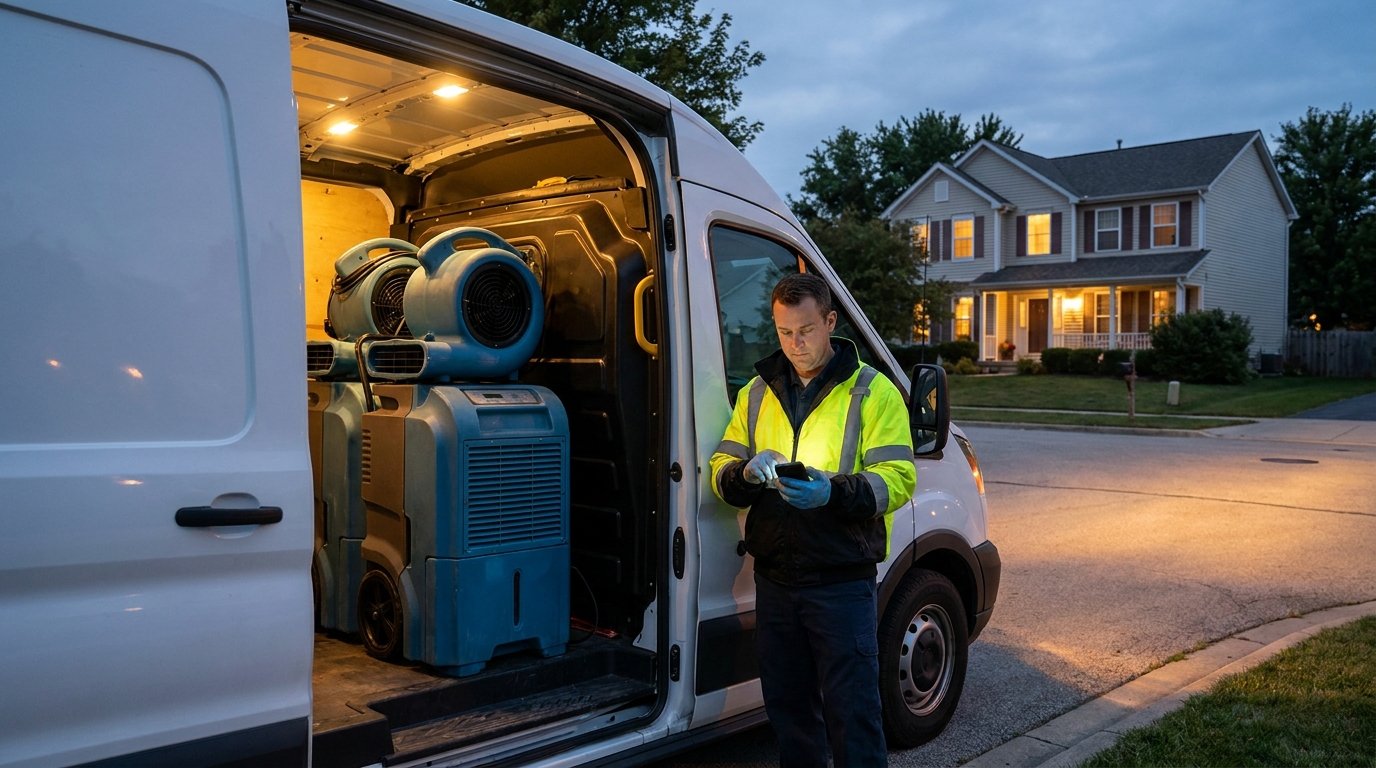
The dispatch looks the same in every language. The intake is what decides whether it happens.
I grew up in Hawaii, and in my six years on restoration trucks I worked in plenty of homes where the first language was Ilocano, Tagalog, or Japanese. The pattern I saw on those jobs never changed: the family had not called the best company in town, they had called the one where somebody’s cousin said “they’ll understand you.” Language was not a nice-to-have. It was the referral network.
Can an AI answering service handle Spanish and English calls natively?
Yes. A modern AI answering service detects the caller’s language in the first seconds of the call and runs the entire conversation in it: the same triage questions, the same job scoping, the same booking and dispatch, with no transfer and no separate phone number. The Spanish caller gets the identical experience the English caller gets, at 2 PM or 2 AM.
That word “natively” is the whole difference. A live service treats Spanish as an exception to route around: find the bilingual operator, transfer the call, hope she is not already on another line. An AI receptionist has no operator pool to manage, so there is no exception to route. Every call is simply answered in the language it arrives in.
Here is the take I give every owner who asks about this: live services sell bilingual coverage as a premium because for them it is a staffing cost. They have to recruit, schedule, and retain Spanish-speaking operators. For an AI receptionist, language costs nothing, so charging a premium for it makes no sense. AI turns bilingual answering from a paid add-on into the default setting, and owners who figure that out first are picking up the callers everyone else is still hanging up on.
For restoration specifically, this matters at the intake level, not just the greeting. The AI still walks a Spanish-speaking caller through the questions that determine dispatch urgency: where the water is coming from, whether it is a supply line or sewage, which rooms are affected, and whether an insurance claim is open. Getting that intake right in the caller’s language is what turns a captured call into a correctly dispatched crew.
What should you look for in a bilingual answering service?
Look for a service that handles the entire call in the second language, answers instantly with no transfer queue, triages and dispatches emergencies, covers both languages identically after hours, and charges no bilingual surcharge. Anything less is a message-taking service with a Spanish greeting stapled on.
Run any provider through these six checks:
- Full-call handling, not greeting-only. Ask the provider to demo a complete Spanish intake: problem scoping, address capture, booking. If the demo is a greeting followed by a transfer, walk away.
- Instant answer in-language. No “para español, oprima dos” followed by hold music. The queue is where emergency callers hang up.
- Emergency triage and dispatch. For service businesses, the call has to end with a tech notified, not a message filed. This is the same standard we set for any answering service for a small business.
- After-hours parity. Many live services quietly drop to English-only overnight, exactly when emergency calls spike. Your after-hours answering service coverage should be identical in both languages at 3 AM.
- Flat pricing with no language premium. Per-minute billing plus a bilingual surcharge means your best-converting calls are also your most expensive ones.
- Transcripts you can read. Every call should produce an English summary and transcript in your dashboard, whatever language the call happened in, so you can review intake quality yourself.
The language gap is a revenue gap
Every stat in this post points the same direction. Spanish-speaking households are the fastest-growing group of American homeowners, they strongly prefer to do business in Spanish, and most service businesses still answer the phone in English only. That is not a demographics story. That is an open lane in your market, and the first company in your area to answer every caller in their own language gets it.
The old way to close the gap was hiring bilingual staff or paying a live service $1.50 a minute for access to theirs. The new way is an AI receptionist that speaks the caller’s language natively, triages the emergency, and dispatches your crew while your competitor’s line is still saying “please hold for a Spanish-speaking representative.”
If you want to know how many Spanish-language calls your market is producing and what catching them would be worth, book a strategy call with our team. We will map your service area’s language mix, your current call flow, and the exact gap between them, then show you what closing it looks like.