July 13, 2026
Marketing for Restoration Companies: What Actually Drives Emergency Calls
A channel-by-channel marketing playbook for restoration companies: local SEO, LSAs, Google Ads, reviews, and the call answering step most owners skip.
TL;DR: The best marketing for restoration companies stacks four channels in a specific order: Google Business Profile and local SEO for the map pack, Local Services Ads for the cheapest emergency leads, Google Ads to fill the gaps, and referral relationships with plumbers and adjusters. Budget 5 to 12 percent of revenue. Then protect all of it, because most restoration marketing fails at the phone, not at the ad.
Restoration marketing has a problem no other trade shares: your customer did not know they needed you until an hour ago. Nobody comparison-shops water mitigation in advance. A pipe bursts at 2 a.m., a homeowner types “water damage repair near me” into a phone with shaking hands, and they hire one of the first companies that answers.
That changes the marketing math completely. Channels that work fine for kitchen remodelers (Instagram, mailers, home shows) barely move the needle when demand is an emergency. Every dollar you spend should be judged by one standard: how directly does it produce a ringing phone during a loss.
I spent six years as a restoration technician before I built RestorationAI.io, and I built it after my uncle lost an $80,000 condominium job to a single missed call. So this guide covers both halves of the problem: the channels that make your phone ring, and the unglamorous step that decides whether those rings become jobs.
What marketing channels work best for restoration companies?
The marketing channels that work best for restoration companies are local SEO with a strong Google Business Profile, Google Local Services Ads, Google Ads, and referral relationships with plumbers, insurance agents, and adjusters. Ranked by cost per lead, referrals and LSAs are cheapest, Google Ads is fastest, and SEO wins long term.
Here is how the four core channels compare for a restoration company in 2026:
| Channel | Typical cost per lead | Time to results | Best for |
|---|---|---|---|
| Referrals (plumbers, agents, adjusters) | $25 to $50, with 60%+ close rates | 3 to 12 months of relationship building | Highest-quality jobs |
| Local Services Ads | $50 to $150 per lead | Days to weeks | Cheap emergency calls |
| Google Ads (PPC) | $100 to $300 per lead | Immediate | Storm surge, new markets |
| Local SEO / content | Roughly $75 per lead at maturity | 4 to 18 months | Long-term lowest cost |
The order matters. Most owners start with Google Ads because it is instant, then burn out on the cost. The smarter sequence is the reverse: claim and build your Google Business Profile first (it is free), turn on LSAs second, use Google Ads to cover what those two miss, and invest the savings in review generation and referral relationships that compound.
One more channel deserves a mention: your own past customers. A finished water job in a neighborhood is a marketing asset. Yard signs, a follow-up text asking for a review, and a note to the referring plumber all cost almost nothing and feed the channels above.
How do restoration companies get on the first page of Google?
Restoration companies get on the first page of Google by winning the local map pack, and the map pack is won with a complete Google Business Profile, a steady flow of reviews, and location-specific service pages. The top three map pack spots earn about 126% more traffic than the businesses ranked below them, so the map pack is the first page that matters.
 For “water damage near me” searches, the map pack is the whole game: three spots, winner takes most.
Work the checklist in this order:
- Complete every field on your Google Business Profile. Primary category (Water Damage Restoration Service), all secondary categories you honestly serve, service areas, hours set to 24/7 if you truly answer 24/7, and real job photos, not stock.
- Build one page per service, per major city you serve. “Water Damage Restoration in [City]” with real project photos, local details, and your certifications. The Restoration Industry Association’s SEO guidance makes the same point: specific, local, expert content beats generic pages.
- Get your name, address, and phone number consistent everywhere. Directory listings, your site footer, your GBP, and insurance vendor lists should match exactly.
- Generate reviews continuously, which is the next section, because review signals feed the same profile that ranks the map pack.
None of this is fast. Organic search takes 4 to 18 months to reach its full cost-per-lead advantage. That lag is exactly why the paid channels exist: they buy you calls while the free channel matures.
How important are Google reviews for restoration marketing?
Google reviews are the single highest-leverage marketing asset a restoration company owns: 87% of consumers read online reviews for local businesses, review signals are a major local ranking factor, and a panicked homeowner choosing between three map pack results at 2 a.m. picks the one with 4.8 stars and 200 reviews almost every time.
Reviews do double duty. They persuade the homeowner, and they persuade Google. Your review count, star rating, reply rate, and review recency all feed the same Google Business Profile that determines whether you show up in the map pack at all. A restoration company with 30 reviews is functionally invisible next to a competitor with 300.
Two practical rules from watching hundreds of restoration companies work this channel:
- Ask at the emotional peak, not weeks later. The best moment is 24 to 48 hours after the job wraps, when the homeowner still feels the relief. An automated text with a direct review link beats a verbal “leave us a review sometime” by a mile.
- Reply to every review, especially the bad ones. Adjusters and property managers read your replies. A calm, factual response to an unfair one-star review is marketing to every future reader.
And remember who else reads reviews: insurance adjusters deciding which contractor to hand a referral. Your review page is your resume for the referral channel too.
Should restoration companies run Google Ads?
Restoration companies should run Google Ads, but only after Local Services Ads are maxed out, because LSAs deliver the same emergency callers at a fraction of the cost. Restoration LSA leads run $50 to $150, while traditional Google Ads leads run $100 to $300; one agency managing both for the same restoration clients reported $69 LSA leads versus $553 Google Ads leads.
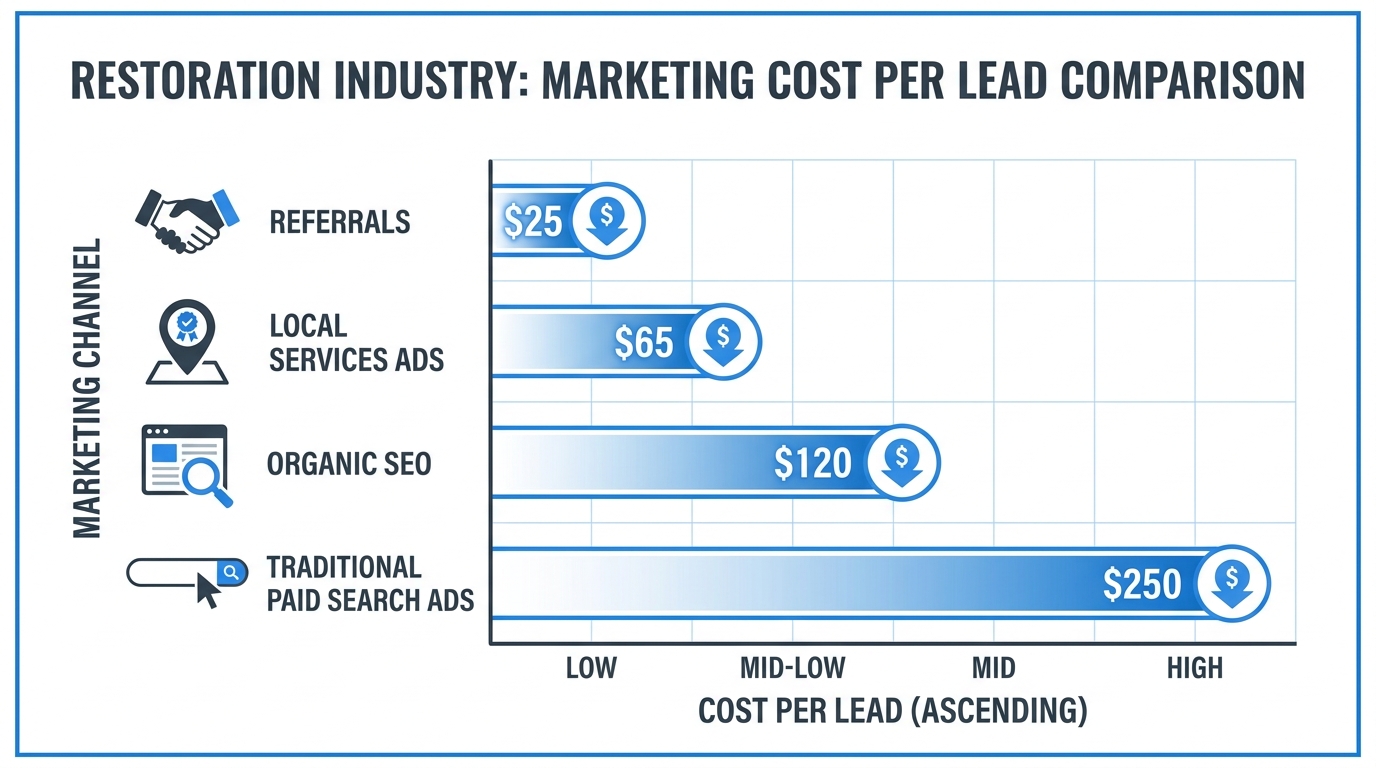 Cost per lead by channel: the spread between LSAs and traditional Google Ads is the biggest arbitrage in restoration marketing.
Why the gap? Water damage keywords are among the most expensive in all of Google Ads, with clicks running $91 to $250 or more, and you pay per click whether or not anyone calls. LSAs charge per lead instead, and they sit above the regular ads with a Google Guaranteed badge that panicked homeowners trust.
So the paid playbook looks like this:
- Get Google Guaranteed and turn on LSAs first. Background check, license, and insurance verification take a few weeks. Do it before storm season.
- Add Google Ads for what LSAs cannot do: specific high-value keywords, commercial loss terms, new territories, and surge weeks when LSA volume caps out.
- Dispute every junk LSA lead. Google charges you for solicitors, out-of-area callers, and wrong numbers unless you dispute them with documentation. This is real money: at $50 to $150 per lead, ten bad leads a month is a truck payment. (This is also a place an AI receptionist quietly pays for itself, because every disqualified call gets logged and tagged with a reason you can attach to the dispute.)
One warning on both channels: paid leads only pay off if every call gets answered instantly. At $150 per LSA lead, a call that rings four times and hits voicemail is not a missed call, it is $150 set on fire plus a $5,000 job handed to the next ad in the stack.
Why do restoration companies lose leads even with good marketing?
Restoration companies lose leads because the call itself goes unanswered or unreturned: 95% of home service companies fail to respond to a new lead within five minutes, yet 78% of customers hire the first business that responds. Marketing gets the phone to ring. It cannot make anyone pick up.
This is the gap I watched destroy marketing budgets for years. In my six years on the truck, the owner was usually the guy answering the phone, and he was also the guy running a crew, meeting an adjuster, and driving between losses. The marketing worked. The phone rang. It rang while he was elbow-deep in a flooded crawlspace, and the homeowner just called the next company on the list.
Run the math on what that leak costs. An average residential water loss bills $3,000 to $7,000, and commercial losses run $25,000 to $100,000 or more. Miss just one emergency call a week at a conservative $5,000 average and you are leaking over $250,000 a year in revenue, while paying $50 to $300 in marketing cost to generate each of those calls in the first place.
After working with over 200 restoration companies, my strongest conviction is this: marketing and call capture are one system, not two. A company converting 90% of its calls with mediocre marketing beats a company converting 50% with great marketing, at half the ad spend. Fix the answer rate before you raise the budget.
Speed is the whole mechanism. Responding within five minutes makes you 100 times more likely to reach a lead and 21 times more likely to qualify them compared to waiting 30 minutes. And the highest-value calls cluster at the worst times: nights, weekends, and storm surges, which is why I wrote a full breakdown of the after-hours answering problem and how the biggest jobs almost never call during business hours.
Whatever you spend on the channels above, put the first dollars into answering: a disciplined on-call rotation at minimum, or an AI answering service that captures every restoration lead around the clock. Your marketing ROI is downstream of your answer rate.
How do you measure ROI on restoration marketing?
Measure restoration marketing ROI by cost per booked job for each channel, not cost per lead: divide each channel’s monthly spend by the number of jobs it actually put on the schedule, and compare that against your average job value. A $150 LSA lead that books 60% of the time costs $250 per job; a $75 SEO lead that books 30% of the time costs the same $250.
The industry benchmark is to spend 5 to 12 percent of gross revenue on marketing, with newer companies at the top of the range and established shops with strong referral networks at the bottom. But the percentage matters less than knowing where each booked job came from. To get there you need three pieces of plumbing:
- Call tracking numbers per channel. A separate tracking number on your LSAs, your Google Ads, your GBP, and your website tells you which channel made the phone ring.
- Outcome tagging on every call. Booked, quoted, disqualified, missed. If calls vanish into an owner’s cell phone, your attribution is fiction. Every call should get logged, recorded, and tagged, which is a core reason we built call analytics into our AI receptionist for restoration companies.
- Job value tied back to source. Your CRM should carry the lead source from first call to final invoice, so you can see that referrals close at 60% or better while shared aggregator leads limp along in single digits.
Once you see cost per booked job by channel, the budget allocates itself: feed the channels that book jobs cheaply, starve the ones that only generate “leads,” and fix the answer rate that quietly inflates every channel’s cost. I broke down the full cost-per-booked-job methodology, including the honest math on answering options, in our answering service versus AI comparison.
If you want to see what your current marketing is really producing, start with your call log, not your ad dashboard. Count last month’s inbound calls, count the ones that became jobs, and look hard at the gap. Then book a strategy call at restorationai.io: we will walk your numbers with you, show you where the leak is, and show you what it looks like when every single call your marketing generates gets answered on the first ring.