July 16, 2026
How to Get Water Damage Leads (Without Renting Them From Aggregators)
What water damage leads cost in 2026, why shared aggregator leads lose, and how to build exclusive lead flow you own and actually answer.
TL;DR: You get water damage leads five ways: Local Services Ads, the Google map pack, plumber and adjuster referrals, Google Ads, and lead vendors. The first four produce exclusive leads you own for roughly $25 to $300 each. Shared aggregator leads cost $150 to $400 and go to several competitors at once. And whatever mix you run, the cheapest upgrade is answering, because 85% of callers who hit voicemail never call back.
A single water damage lead can cost more than a new air mover. In competitive markets, one lead runs anywhere from $80 on Local Services Ads to $1,250 from an exclusive pay-per-call vendor. That price makes sense on paper: the average residential water restoration job bills around $3,867, and the average insurance payout for a water claim lands between $11,098 and $12,514. One closed lead can pay for fifty misses.
That math is exactly why the lead-selling industry exists, and why so much of the advice about water damage leads is written by companies that want to sell you theirs. I come at this from the other side. I spent six years as a restoration technician, then worked with over 200 restoration companies after I built RestorationAI.io. This guide covers where the leads actually come from, what each source really costs, and the leak almost every owner ignores: the leads you already paid for that die on an unanswered phone.
How do you get water damage restoration leads?
You get water damage restoration leads from five sources: Google Local Services Ads, the Google map pack (your Business Profile plus local SEO), referral partners like plumbers and insurance adjusters, Google Ads, and purchased leads from vendors or aggregators. The first four generate exclusive leads you own. The fifth rents another company’s lead flow.
Here is each source in one line:
- Local Services Ads (LSAs). Pay-per-lead ads above the regular search results with a Google Guaranteed badge. Usually the cheapest paid emergency calls in restoration.
- Google map pack and local SEO. Free once you rank. A complete Google Business Profile, steady reviews, and city-level service pages put you in front of “water damage near me” searches.
- Referral partners. Plumbers, insurance agents, adjusters, and property managers who call you directly from the loss. Referral leads run $25 to $50 with close rates above 60%, the best economics of any source.
- Google Ads. Instant volume, at a price. Water damage keywords are among the most expensive in home services, with clicks reaching $91 to $250 or more.
- Purchased leads. Aggregators like Angi sell one homeowner to several contractors. Exclusive pay-per-call vendors sell each lead once, for a lot more money.
I broke down how to build and sequence the first four channels in my full guide to marketing for restoration companies. This post goes deep on the piece that guide could not: the buying decision, and the capture problem hiding under all five sources.
How much do water damage leads cost?
Water damage leads cost between $25 and $1,250 each depending on the source: referrals run $25 to $50, LSA leads run $80 to $250, Google Ads leads run $100 to $300, shared aggregator leads run $150 to $400, and exclusive pay-per-call leads typically run $275 to $700, with some markets topping $1,000.
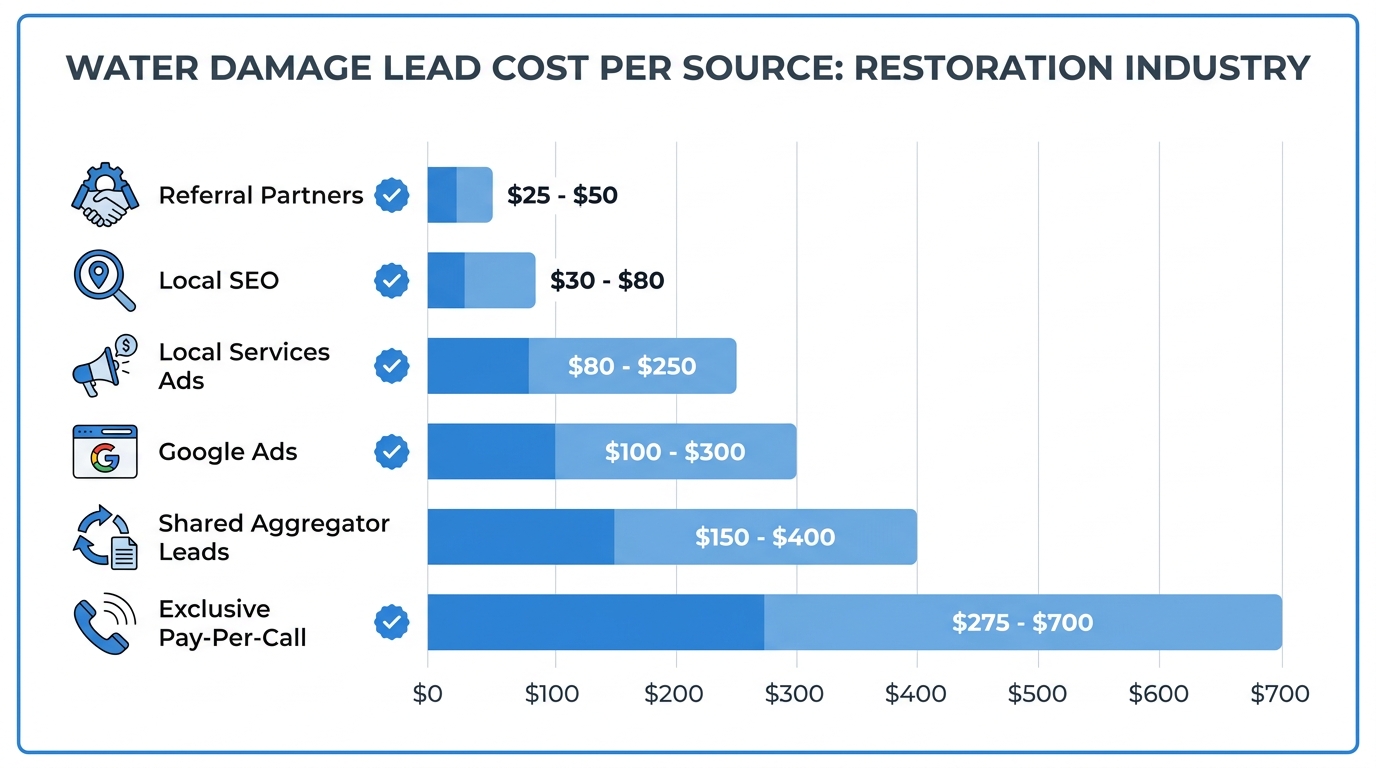 Cost per water damage lead by source. Exclusive means only your phone rings.
| Lead source | Typical cost per lead | Exclusive? |
|---|---|---|
| Referral partners (plumbers, agents, adjusters) | $25 to $50 | Yes |
| Local SEO / map pack (at maturity) | $30 to $80 | Yes |
| Local Services Ads | $80 to $250 | Yes |
| Google Ads (PPC) | $100 to $300 | Yes |
| Shared aggregator leads (Angi, HomeAdvisor) | $150 to $400 | No, sold to multiple contractors |
| Exclusive pay-per-call vendors | $275 to $700 industry range | Yes, but you rent the flow |
Two things jump out of that table. First, the leads you generate yourself sit at the cheap end, and the leads you buy sit at the expensive end. Second, the only row that is not exclusive is also the one most new restoration owners try first, because aggregators make signing up easy.
Prices spike with weather. During a hurricane landfall or a freeze event, per-click auctions on restoration keywords brush $250, and vendors raise per-call rates to match. Budget for the surge weeks, because that is when the biggest losses call.
Are paid water damage leads worth it?
Paid water damage leads are worth it only when the lead is exclusive and you answer it within seconds; shared leads sold to multiple contractors turn every $150 lead into a phone race, and 78% of customers hire the first business that responds. Judge every source by cost per booked job, not cost per lead.
The cost-per-booked-job math is where shared leads fall apart. Angi-style shared leads go to as many as 3 to 8 contractors at once. Say you pay $200 for a shared lead and close 10% of them because seven competitors got the same homeowner. That is $2,000 per booked job. An exclusive $425 pay-per-call lead closed at 40% costs about $1,060 per job. A $35 plumber referral closed at 60% costs $58. Same trade, same town, a 34x spread.
Buying shared water damage leads is a game you lose on both price and exclusivity: you bid against seven competitors for the same flooded basement, then race them to the phone. In six years on the truck and hundreds of restoration companies later, I have never met an owner who won that game long term. The owners who grow build lead flow they own, then make sure not one of those calls leaks to voicemail.
So here is my honest buying rule. Use exclusive pay-per-call vendors as a bridge while your LSAs, map pack, and referral network mature, and cap them at a share of volume you could lose tomorrow without panic. Treat shared aggregator leads as a last resort, priced with the race baked in. And never buy any lead, shared or exclusive, until your answer rate is fixed, because a purchased lead that rings out is the most expensive miss in the business.
How do you get exclusive water damage leads instead of shared ones?
You get exclusive water damage leads by generating them yourself through Local Services Ads, the Google map pack, and referral partnerships, or by buying from pay-per-call vendors that sell each lead to only one contractor. Self-generated leads are the only kind that get cheaper every year you invest in them.
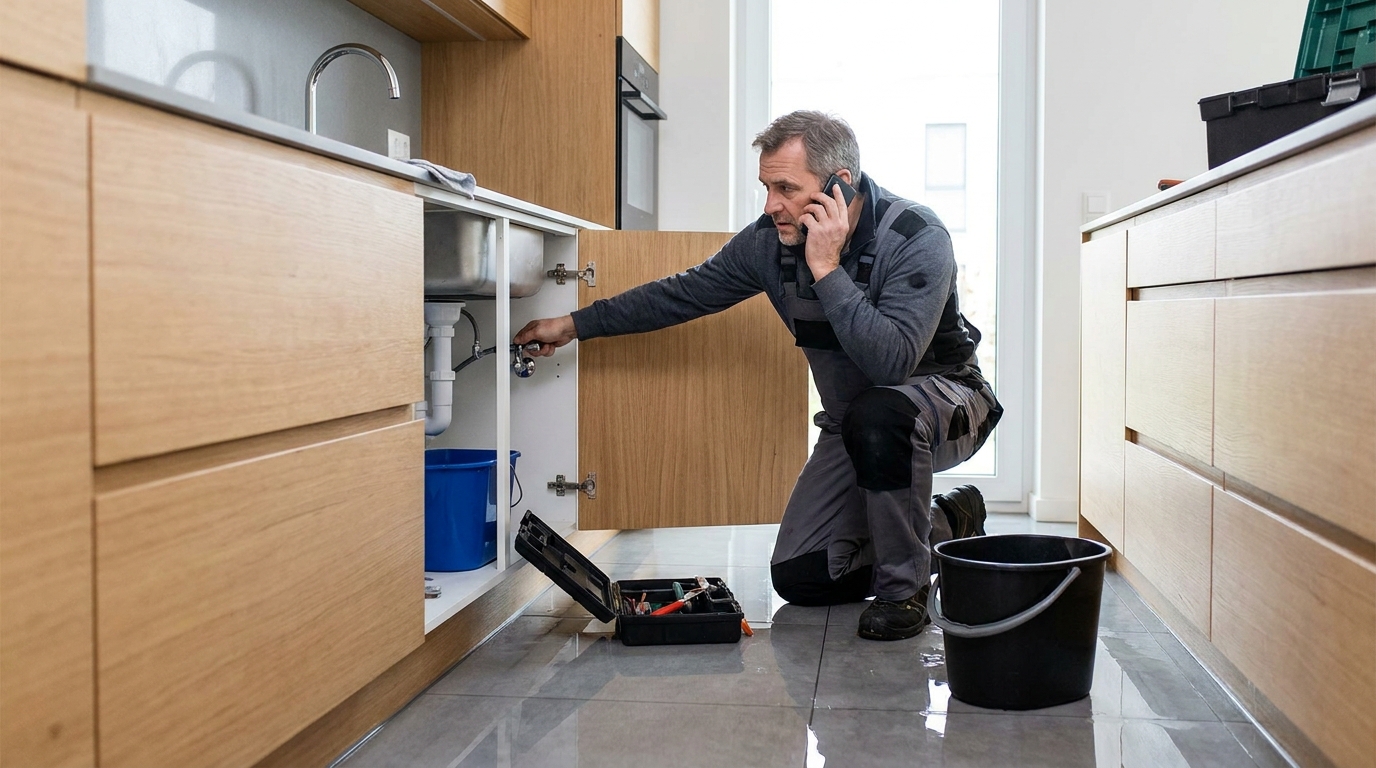 The best exclusive lead in restoration: a plumber standing in the loss, calling you first.
The highest-value exclusive source is not digital at all. Plumbers are the number one source of quality water damage referrals because they are standing in the emergency when it happens, and what they need from you is simple: answer instantly and dispatch fast, every time, so they look good to their customer. In my six years on the truck, the best jobs I ever ran came off a plumber’s cell phone, not an ad. Build those relationships with reciprocal referrals and relentless responsiveness, and they compound like nothing you can buy.
The digital playbook for exclusive flow, in order:
- Turn on Local Services Ads first. Get Google Guaranteed before storm season. LSA leads are exclusive to you at $80 to $250, and you can dispute clearly invalid calls.
- Build the map pack asset. Complete Google Business Profile, 24/7 hours you actually honor, steady review flow, and a service page for each city you cover. Organic leads settle near $30 to $80 each at maturity.
- Add Google Ads for surge and gaps. High-intent emergency keywords, commercial loss terms, and storm weeks when LSA volume caps out.
- Formalize the referral network. Plumbers, agents, adjusters, and property managers, with a real system: instant answer, same-hour dispatch, and updates back to the referrer on every job they send.
Notice what all four have in common: when they work, your phone rings, and only your phone. Which makes what happens next the whole ballgame.
Why do water damage leads go to your competitors?
Water damage leads go to your competitors because they answer first: 85% of callers who reach voicemail never call back, and responding within five minutes makes you 21 times more likely to qualify a lead than responding in 30 minutes. A homeowner standing in two inches of water does not leave a message. They dial the next result.
This is not theory for me. My uncle was a genuinely good restoration contractor, the kind adjusters trusted and plumbers recommended. One evening a property manager called him about a water loss in a condominium building. He was on a roof, or in a crawlspace, or just driving. The call rang out. By the time he called back, another company had answered, gotten the work authorization signed, and taken an $80,000 job that should have been his. One missed call. That moment is why RestorationAI.io exists.
Run the restoration-specific math on that leak and it gets uncomfortable fast. Take a conservative $3,867 average residential job, and an $11,000 to $12,500 average when insurance is involved. If your line misses just two real emergency calls a week and you would normally close a third of them, that is roughly 35 lost jobs a year: somewhere between $135,000 and $400,000 in revenue, leaked by a phone that nobody picked up. You paid marketing money to make it ring.
The misses cluster at the worst times, too. Water losses do not respect business hours; pipes burst at 2 a.m. and sump pumps fail on holiday weekends, which is why I wrote a full breakdown of the after-hours answering problem. If your after-hours plan is “the owner’s cell, hopefully,” your competitors already have a name for your overflow: their lead flow.
How do you stop losing the water damage leads you already generate?
You stop losing water damage leads by making sure every call gets answered live, within seconds, 24 hours a day, and then qualified and dispatched on the spot. Before you raise any lead budget, fix the answer rate, because capture improvements multiply the return on every lead source you run.
Your options, from cheapest to most capable:
- A disciplined on-call rotation. Free, and better than nothing, but it fails exactly when it matters: storm surges, 3 a.m. calls, and days when the on-call tech is in a crawlspace with wet hands.
- A live answering service. A human picks up, takes a message, and relays it. That beats voicemail, but message-taking is not dispatch, and per-minute billing punishes the surge weeks when calls stack up. I compared the real numbers in my answering service versus AI breakdown.
- An AI receptionist built for restoration. Answers every call in seconds, asks the intake questions a restoration job actually requires (water category, source, insurance carrier, affected areas), sends the work authorization, and dispatches your on-call tech while the homeowner is still on the line. I wrote up exactly how that works in practice in my guide to the AI answering service that captures every restoration lead.
Whichever path fits your shop, the sequence is the thing to get right. Fix capture first. Then turn on LSAs, build the map pack, and feed the plumber network, and every one of those channels gets cheaper per booked job because nothing leaks out the bottom.
If you want to see your own leak before you spend another dollar on leads, pull last month’s call log and count three numbers: calls in, calls answered live, and jobs booked. Then book a strategy call at restorationai.io. We will walk through your numbers with you, show you where the leads are dying, and show you what your existing lead flow is worth when every single call gets answered on the first ring.